

Clark Thenhaus of Endemic
Clark Thenhaus is the Director of Endemic, which operates through a multi-valence of interests synthesized through careful readings of cultural context, politics, history, and the discipline of architecture as an intellectual project. The office name, Endemic, accepts the traditional meaning concerning context, language, and material sensibilities as an intensely local cultural condition. Clark earned his Master of Architecture degree from the University of Pennsylvania where he studied as the recipient of the three-year Fideli Fellowship and was awarded the Dales Scholarship. He is a recipient of the 2015 Architectural League Prize for Young Architects & Designers, a 2014 MacDowell Art Colony Fellow, and was previously the 2013–2014 Willard A. Oberdick Fellow at the University of Michigan Taubman College of Architecture + Urban Planning. Thenhaus is currently a full time visiting faculty at California College of the Arts in San Francisco. Recently, Modelo had the opportunity to learn about Clark’s philosophy and unique approach to design.

On becoming an architect
It seems like there’s two categories with architects. There are those of us who came to it early and those of us who came to it sometime in college. I’m of the former, coming to it early. For me it actually happened in fourth grade. My teacher’s husband came to visit the classroom and being curious kids we asked him what he did. He was an architect. I had no idea what that meant so I asked, ‘what does an architect do?’ My teacher told me that he draws houses. I thought to myself, ‘cool I live in one of those!’ That was enough for me to start thinking about being an architect. From that moment on I went home and started drawing houses that day. I think my parents still have drawings from that time actually. So that’s when I began and I’ve never really wavered from it since.
On his influences
There are definitely a few important influences for me. I’m not sure I could point to one singular authority or influence for me but my time in grad school was incredibly formative. A number of the faculty that I was studying with there were influential in what I went on to do and in what I am doing now. That was the kind of moment when I was blissfully naive on the one hand and overly ambitious on the other. That can be a nice combination sometimes in grad school. After that I went to work for John Enright and Margaret Griffin for a number of years in Los Angeles. That was a really wonderful experience because they also got me involved in teaching. So that model of critical practice and teaching was certainly influential. I could point to a couple of figures in history that are inspiring but I wouldn’t necessarily think of them as influential.
Most recently, however, I think over the last few years the strongest influences for me come from conversations with colleagues and friends from my own generation, as well as their work. Those kinds of conversations have become a greater influence to me now in how I think about my work as well as other people’s work.
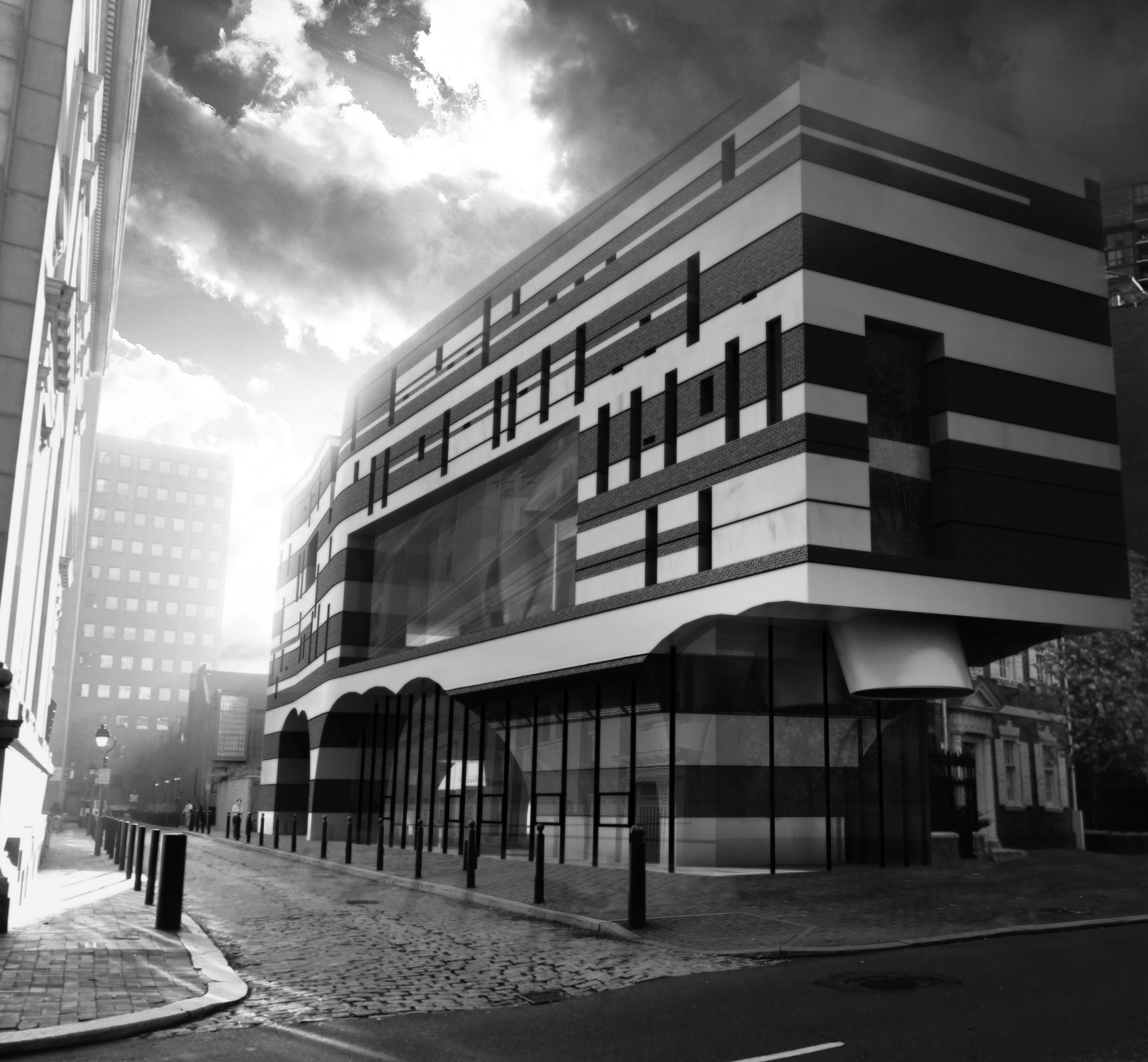
 “Athenaeum” (Rendering courtesy of Endemic)
On starting his firm Endemic
The how and the why are two separate things. The why had more to do with wanting to pursue my own interests in architecture in a way that you sometimes cant working for somebody else. The how it happened has certainly been the more challenging part. It really started through teaching and a sort of exuberance about working on stuff – anything – competition, self-funded work, a small interior project, didnt matter. This was a nice partnership to be teaching and to start thinking about my own ideas through working on them in various ways. It took a couple years to just work through some ideas and figure out where I really wanted to go, but to also figure out what was important to work on and what wasnt. I think a lot of times when people start their own business or studio they go into it with a lot of energy and excitement. In my case it was that, but there was also some naivete about it. The work has evolved out of a restlessness of interests.. In a lot of ways it’s been a shifting target just exploring and doing different things, but in other ways it’s pretty careful focusing of particular interests. Some is built and some is research, which is a lot of fun. The research is a lot of fun because it allows you to keep moving forward in ways practice based projects don’t always allow for. Once you become static or stagnant in a research project I think it’s time to put it away and move onto something else.
The other thing I would say about my trajectory is that it’s one that has been quite mobile. So it’s been nice to develop a pretty broad network internationally and here in the US. This has opened up a lot of unforeseen doors, projects, things to work on – even just this morning having been asked to design a sunflower field in Australia, which is pretty cool since it’s a rather unique thing to work on. Those kinds of things you can’t really plan when starting an office, and I’m not sure I really have an office yet either. I don’t really call it that. But I do think the more important thing starting out is designing opportunities as opposed to only designing things, this has been quite formative for me.
On the principles he strives to achieve across projects
Across all of my projects is an ambition to sync aesthetics with politics, technology with materiality, history with contemporary culture, or form with context and these kind of broader things for me are a way to unite disciplinary concerns with an expanded field of influences. This affords specific strategies for form-making and allows me to think about relationships between form-making and context in different way. Form doesn’t always need to be contingent on context, sometimes form can precede context and at times form can actually reauthor the context.
A lot of my recent projects have been concerned with returning to primitve geometries and aggregations of existing, seemingly unremarkable forms into new arrangements. I call these Generic Originals. So it’s not about creating new forms or new typologies but rather rethinking ones we are already familiar with.
On projects that represent his unique approach
A belvedere is an elevated platform for looking out over a particularly pleasing scene. In the Belvedere project the belevedere appropriates a more complex landscape with a past political imperative, that of a post-military landscape with a missile silo. The interesting thing to me in this project is not the relationship of the military silo to the broader network to which it’s part but the atomization from its network. The more compelling point of entry into this scene is not by virtue of its status in a relational network, but rather the autonomous qualities of the missile silo and landscape itself. By dislocating the silo from its contingency in the network allows us to focus on more objective architecture problems. In this case the belvedere appropriates it by sitting on top of it. That calls into question a few things. One is typology. One is the relationship between the form and its context. The other is about how form might re-author a particular context while de-concealing this past political imperative in a seemingly banal pastoral scene.
Another project, A Project Four Domes is a similar form-making strategy that uses spheres, cones and cylinders but also turns attention to a longstanding typology of a dome, one of the typologies I call a Darling typologies in architecture. Darlings are a more recent idea I have just started writing about and working on, but they are what I would claim as domes, columns, arches, vaults, belvederes, even dormer windows could be a Darling. These are things that endear themselves to the discipline, and in so doing locate an intellectual project in history but also foster successive generations to work on them in new ways. Another category might be Brutes, which I would suggest are schools, office parks, or hospitals– the city planning slugs and policy makers of modern typologies. So A Project Four Domes resides within a genealogy of the dome typology, but intends to offer it new expressions. The domes mark the center of America, of which there are actually four middles of America – a spatial paradox of boundaries and centers. These pastoral points in the US don’t really condition form in any way but they don’t leverage a response either. But by introducing domes to these contexts that are generally unfamiliar with a dome, it calls attention to these odd geographic anomolies that recast architectural form and context into a different relationship that changes our perception of these kinds of sites as well as the formal, spatial, and material qualities of domes.
On his process
I don’t like talking about process usually, especially about how things are made. Too much talking about process can drive the conversation towards things like the fidelity to technique or virtuosity of technology and I like talking about content more. But generally speaking, digital modelling is a large part for me. Generally we’re using Rhino 3D modelling software and a handful of other plugins for that. In terms of fabrication software though, it always varies. As far as representation, I’m interested in large scale models – the Belvedere model is about eight feet tall and the domes are around five and half feet. So that requires a different sensibility of how you go about making something. It can’t hinge as much on abstraction, or at least not quite as easily. So that introduces other problems with the actual making of the thing. Procedurally for me the work always begins with digital modelling. If there is hand sketching involved it’s usually pretty quick and gestural. Most of the work happens through the computer. It’s also true that most of the people that I work with are often dispersed in different cities. So the digital environment for me becomes a way to trade models and information more easily.
On the future of architecture in the next 5-10 years
I think there are a couple of places change could come to. What’s troubling on the one hand but also necessary is the movement or drive towards sustainability as a kind of commodity – and one that has become a global narrative of the profession is becoming seen. Its not that its not important, but that as a conversation or point of emphasis it’s problematic in that it drives attention away from other modes of sustainability that we could be talking about such as cultural or disciplinary sustainability in the field. I’m not sure that that is a huge disruption but I also think that its symptomatic of the tendency to subdivide and carve out a niche, and that the further we drive issues into sub-categories within the field, the less of conversation we can collectively have.
But of course there will also always be changes in technology that shift conversations – hopefully towards architectural problems and applications – as well as seminal projects that spur new modes of attention and debate. But overall, it seems likely that the field will continue to subdivide into different expertise groups and that shared interests usually common to the field will dissipate into other fields – architecture could possibly have less and less to do with buildings, built environments, or disciplinary research.
On the future of Endemic
The goal, is to continue to build a practice concerned with buildings. The other part of that though is that I don’t want to forgo research and the academy. I think they’re very beneficial to one another. I’m currently working on a project for a full-scale dome with a non-profit with hopes of building it next year in Los Angeles if we get funding. For me that project would be a really great way forward, bridging between the last one or two years of research concerned with the typology of domes into a full-scale built work for public use. The goal of the next five years is to continue building a practice through projects while contributing to the academy through design research, education, and writing.
On advice he would give his younger self
That’s a tough one since so much that has happened was completely unpredictable. The advice I would give though is two things. First, be scrappy. You have to be scrappy and go after things as hard as you can and realize you just don’t always win. I spent too much time in the first year or two being more scratchy than scrappy….Gotta be scrappy and then make the most of your opportunity. The second piece would be that it’s more important, especially when starting out, to design opportunities as much as you design a ‘thing’ or a competition, or whatever. If you can figure out how to design opportunities or put yourself in the right place, it can open totally unforeseen doors. I learned that after a few years, but wish I had sooner.