

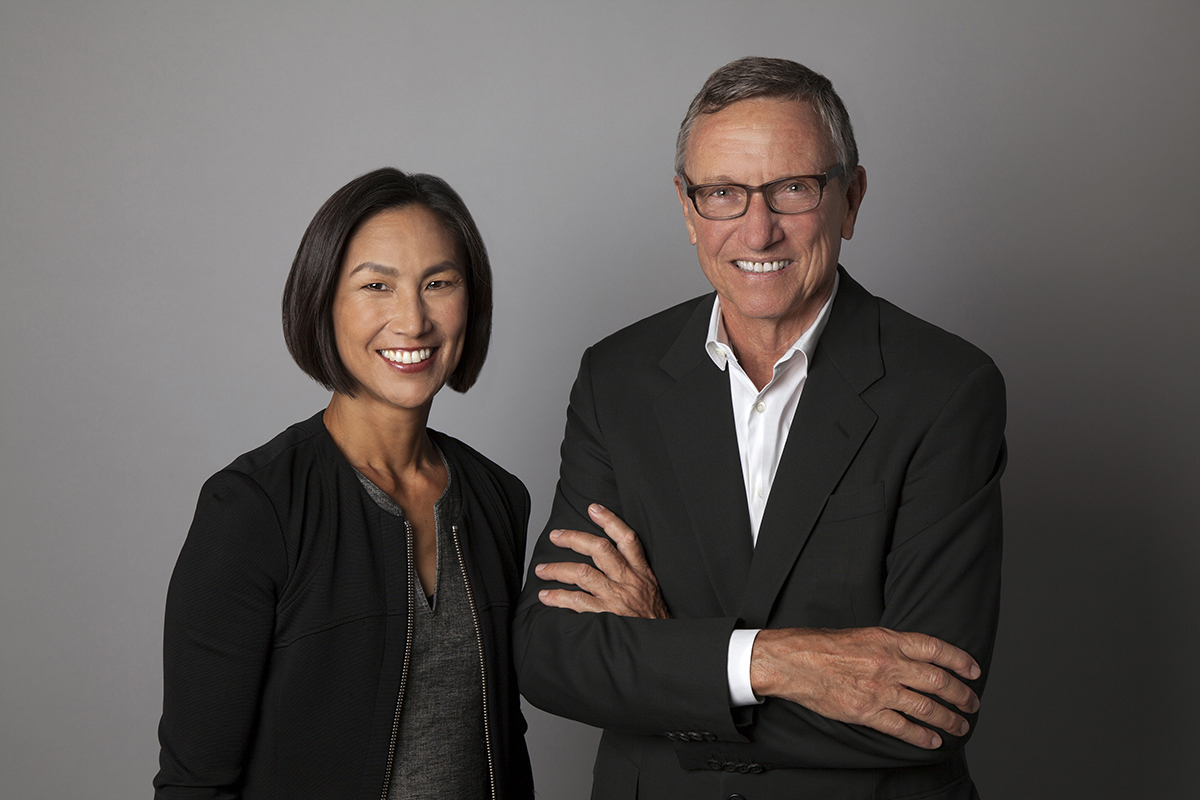
Richard Gluckman and Dana Tang of Gluckman Tang Architects
Dana Tang and Richard Gluckman are partners at Gluckman Tang Architects, a multi-faceted firm offering services in architecture, planning and interior design. Over nearly 40 years, Gluckman Tang has grown from a studio focused on art installations and galleries to an internationally-recognized firm with a body of work that includes museums, educational institutions, retail, residential and commercial projects. Gluckman Tang is renowned for its sensitive interventions into historic structures and for ground-up buildings that are responsive to their context. Their design sensibility is shaped by a history of close collaboration with artists and curators, and by their commitment to enhance the public realm and enrich the human experience. Recently, Modelo had the chance to learn more about Dana and Richard’s unique approach and design philosophy.

On becoming an architect
Richard: I liked to draw when I was a boy. I grew up in Buffalo, NY, and enjoyed being driven by my father through the post-industrial landscape of the city: the steel mills, the grain elevators, and the shipping terminals — all still in service. It was a great landscape for a kid.
When I was 9 years old, my father used the word “architect”. His explanation was simple: “an architect draws buildings that get built”. My path was clear.
I studied architecture at Syracuse University, where I had 3 great teachers and very supportive parents. As a second year student, I had the opportunity to design and then build my parents’ house in the Glenwood Hills, south of Buffalo. By the time I graduated, I had completed 2 other weekend houses. These early projects were formative experiences for me. They gave me an understanding of the ‘build’ side of design/build and the confidence, and desire, to form my own office. While working in an office in Boston, I was offered the opportunity to help a client sail his 30’ boat from Scotland to Cape Town; a true adventure and one that bred a different kind of confidence. I came to New York in 1976 to set up a practice with my college roommate, Fred Stelle.
Dana: I grew up in New York City. For me, there were a few touch points that led me to architecture. The first was in kindergarten when the teachers had to make a rule that I was not actually allowed to play in the block area because that was all I did. I liked building things from the very beginning, and I spent much of my childhood building things in the woods by myself on weekends. I had siblings and none of them would join me. I’d go off in the woods to build all kinds of constructions out of sticks, trees, and leaves.
When I was a freshman in college I worked as a summer intern in the office of Lo Yi Chan. I did a passable job as an intern, but he urged me to pursue a liberal arts education and not to focus on architecture right away. So I followed his advice and went into another field entirely and was headed for a different profession. It was when I was teaching Chinese language and literature at Colorado College that I decided to drop it all and go to architecture school. It was the second path for me and I’ve loved it since.
On discovering their voices as architectural designers
Richard: My first project in New York was the renovation of a townhouse for Heiner Friedrich and Philippa DeMenil, the founders of the Dia Art Foundation. At this time, I was introduced to the work of minimalist artists of the late 60’s and 70’s and installed 2 site-specific works by Dan Flavin. Their art had a profound impact on my thinking as an architect.
Through their influence, I learned to treat the space as a frame for the art installation and to privilege the relationship of the viewer to the art to the space that they occupy. This basic tenant has informed all of our subsequent work and is fundamental to the success of our projects.
Dana: One of the things that I learned from Lo Yi Chan was that architecture is an interdisciplinary profession. In other words, architects can’t exist without everybody else. It’s not an art form where it’s about our own individual expression — it’s about the user, the program, the context, and the cityscape. He taught me that being a good architect is having the capacity to understand and incorporate all of these other pieces — context and program and users that come into play in designing a building or a space. That’s a key piece of what we continue to do now at Gluckman Tang. Of course, Richard has also influenced me a great deal during our twenty years of working together.
On how the firm has evolved over the past years
Richard: Art-related projects have been the mainstay of our firm throughout its development of nearly 40 years and they continue to sustain us today. Our residential work has always been an interesting and important part of the practice as well. Over the past 15 years, we have also pursued and designed projects for academic institutions. We recently completed a new College of Law for Syracuse University and are working on a small but significant project for Drexel University. Fortunately, we have had the opportunity to work internationally, and have completed projects in Spain, England, Germany, Japan, and the People’s Republic of China.
Dana’s efforts to bring in work of different disciplines and scales has helped the firm to evolve. In particular, Dana has been the catalyst for our first projects in China: the Zhejiang University Museum of Art and Archaeology and two other museums in Shanghai. All three are ground-up buildings. These projects have broadened and strengthened our practice, reinforcing our previous repertoire of interventions into existing buildings with experience creating entirely new structures.
Our relationship to the art world has been fundamental to our practice. Working with and being exposed to artists like Dan Flavin, Walter De Maria, and Richard Serra has had a profound effect on how we conceive space and make form. Our work today continues to be influenced by new artists, notably Jenny Holzer and Bill Viola. Accordingly, when I talk with students today, I urge them to experience as many large-scale art projects as possible and to make sure that they acknowledge the artists who influence their designs and their aesthetic sensibilities.
Dana: The office has benefited tremendously by the variety of work that we’ve done. Richard mentioned diversity in terms of scale and types; from the beginning, our office has designed a wide variety of projects, balancing residential, museum, gallery, commercial, and institutional projects simultaneously. We’ve had the good fortune to be able to work for developers who care about the architectural outcome. We did a high-rise residential building here in New York, as well as a spa complex (Mii amo), for a developer in Arizona. We’re doing a small private art pavilion for private residents, while at the same time, building a 25,000 square meter museum. This contrast keeps us engaged with the range of issues that come up on projects of varying scale and type. The greatest part about designing all of these projects is not the individual project, rather, that all previous projects inform our future work. Now, the work that we’re doing in China, even though it has its own criteria and culture, influences all of the work in our office going forward.
On specific projects that represent the firm’s approach
Richard: We have what we call legacy projects: projects that are distinctive and are breakthroughs for our firm. The first of these was the Dia Center for the Arts at 541 w 22nd street in Chelsea in 1985. It was the manifestation of our earlier work with Dia’s minimalist, site-specific artists who catalyzed our reductive approach to contemporary interventions within existing structures. This led to The Andy Warhol Museum and subsequent museum projects. It also engendered the trust of directors, curators and artists who trusted that we understood, respected and reinforced their intentions for the work.
Our art-related projects led to fashion projects in the late 80’s as those two worlds converged. Helmut Lang thought like an artist and immediately understood our idea for his project. We inverted the standard expectation for retail design and won five awards for this store. The store is (or was) totally ambiguous, inspired in part by a Tony Smith installation called ‘Crazy Eights’ that I had seen years earlier and influenced by a conversation with Richard Serra. Upon entering the store, three black rectangular volumes greeted the visitor and mediated the volume of the space to the scale of the object of desire. Having helped Jenny Holzer install a work in the first store, we collaborated with her in a significant way on Helmut Lang’s Parfumerie across the street.
The Museo Picasso Málaga may be our most representative project to date. It demonstrates our vision for the relationship between historic and contemporary buildings. It’s a mutually supportive balance of preservation and intervention. The project fits well, contextually, in the city of Málaga where we created a new urban space within a historic precinct. It is an example of another of our basic precepts: great results demand the collaboration of great clients; in this case, Carmen Giménez, one of the foremost curators in the world.
On their collaborative efforts
Richard: I’ve always believed that architects need to collaborate closely with consultants from the inception of the design idea. At Gluckman Tang, we believe that an integrated building design is essential for creating good architecture and architectural space. Although I didn’t always share that belief with regard to my own associates, our process has evolved over the past few years and we now practice a far more collaborative approach within our design teams. We build consensus with regard to our reconciliation of the program, the site, and our design strategies.
On the aspirations for the firm
Richard: We hope to expand and to push ourselves further as a firm. We’re fortunate to have a diverse range of projects and we hope to continue our work in our current market sectors: cultural, institutional, academic, hospitality, and residential. We wish to further advance our work internationally as well, especially in China where we have been working for the past 9 years.
Dana: We would like to continue our success, advancing our current progress and bringing in similar work. It feels like we’re building momentum; we’ve just finished a couple of successful and significant projects, including the Syracuse University College of Law, which was a big building for us. I do think every project informs the next project. It is exciting to be able to take what we learned on a completed project and apply it to the next one. I would like to see us doing more environmental buildings. We’ve completed LEED-certified buildings and will continue to do that, but I’m hoping we can do more projects that are programmed from the very beginning of design, with an integrated team of engineers, to meet even higher standards.
Richard: Throughout my career I have always believed that sustainability issues were simply common sense. I know now that it’s much more sophisticated, collaborative and cross-disciplinary. I am most interested in sustainably-oriented site infrastructure: landscape design, water retention strategies, urban planning and engineering.
On the future of architecture in the next 5–10 years
Richard: Design and engineering have been integrated for a long time but now we have the tools to expand that integration and to further harness it in order to realize better architecture. With the inclusion of BIM management, the integration of design, construction, fabrication, and implementation has become the future of the design process and has led to a more cohesive integration of architects, engineers and builders. It is a more efficient way to design. I’m interested in the efficiency of the design process as well as the result of the construction process. A big budget is not a prerequisite for good architecture.
Dana: People are becoming more focused experts in their individual fields and today there are more fields of expertise within our industry. It takes more professionals and more expertise to complete a project today because there is simply more information to apply. Individuals cannot possibly know deeply about all of the different fields applicable to the modern design process. The role of the architect is to bring all of that information together from all the necessary experts, and to coordinate all of it in order to design a better place. Our role as the hub of all that information will continue to grow.
On advice they would give their younger selves
Richard: I wish that I had put more effort into balancing practice with academia. Having taught, I’ve learned that being a good teacher is hard work. It takes a lot of focus. I would tell my students that all architecture is experiential. You have to discipline yourself to see more and experience more, constantly.
Dana: My advice would be to draw more and to see more. Doing a lot of free-hand sketching as a young person goes a long way toward being able to take what you see in the physical world and apply it in design. Taking full advantage of younger years to go out and actually see as much as possible before you’re encumbered by spouses, children and full-time jobs is very important.
Richard: What both of our comments suggest is that we wish we could have done more of what we already did; this would have only made us better. We haven’t made any big, fundamental mistakes — we’re very fortunate.