

Oliver David Krieg
Oliver David Krieg is a doctoral candidate and tutor at the Institute for Computational Design at the University of Stuttgart. With the completion of his Diploma degree in 2012 he also received the faculty’s Diploma Prize. Prior to that, he was working as a Graduate Assistant at the institute’s robotic prototype laboratory “RoboLab” since the beginning of 2010. With a profound interest in computational design processes and digital fabrication in architecture, he participated in several award winning and internationally published projects. In the context of computational design, his research aims to investigate the architectural potentials of robotic fabrication in wood construction. Recently, Modelo had the opportunity to learn more about Oliver’s unique approach to design.

On his decision to join the ICD
While classic architecture is mostly focused on design aspects, in the end it comes down to my passion for a more scientific approach to the decision process in architecture. I’ve always felt these two poles, I’ve always liked to think about design but then it was never enough for me. I needed to analyze the underlying decision process, and computation and programming came very close to that.
At an early point during my studies I realized that the field of architecture wasn’t actually using the computer, although it could be used not only for drawing, but actually for a much smarter design process. That made a lot of sense to me. That was in 2008, when I was in the middle of my studies. Shortly after joining the ICD I realized that many architects and engineers are not aware of the possibilities of employing the computer and its computational power when your design becomes parametric and adaptive. That inspired my fascination for technology, machines, and ultimately robots. But, I realized there is so much opportunity. As architects we are not always inventing new things but we’re using existing technology and we employ it in a different context or combine it in a new way. It’s actually just ahead of us and we have to grab it, which was really interesting to me.
The ICD is a multidisciplinary team of researchers founded and directed by professor Achim Menges. Through his work and his support I had the opportunity to participate in exceptional projects. It’s important to contextualize that I’m one part of ICD and there are many other colleagues working in different research fields.
On his research
My research focuses on the possibilities of wood construction in the context of computational design and digital fabrication. Why wood construction? First of all, wood is a natural material. It’s also a material that really benefits from the processing capabilities that industrial robots have. Other materials will benefit as well, but I think that wood is a material that makes it easy to work with. And of course it’s a material many like to work with — it’s not too heavy or too hot or toxic. I’m looking into how all these new possibilities in fabrication — actually the whole production process in timber construction — could possibly change and result in different construction systems and building systems in wood. I came in touch with that field of research when I was looking into classic wood connections and how they could be reinvented or revived through digital fabrication. The natural consequence of that is the question about how to handle the pieces, the elements, the building parts, and the whole logistical chain behind it. All of that can possibly change through a digital fabrication process, but all of it is linked.
On the implications in his research
At the institute we are looking into how computational design and digital fabrication can change architecture and construction. Our research is based in technology, computation, IT, and biology. For us architecture is the answer to the question on how building elements are arranged and combined in relation to the program. The result is always related to the construction system that is used. If you completely change the construction system you also change the possibilities of this relation. The finger jointed plate structures that we developed are a good example. They can be arranged in a rectangular manner but they can also formulate very organic articulations.
Adaptive and parameterized construction systems like the ones we are developing at our institute are free from the geometric constraints of modern architecture. This paradigm change will also change the way we think about architecture. But in the end it will only revive the question that was already forgotten: is architecture just defined by the fabrication technology and by the production techniques that are currently available? If that constraint, which is a result of the industrialization, our design possibilities will be so much more diverse. Then the question arises what spatial articulation makes sense form a structural and architectural point of view?
On key projects
We have an amazing team at the university. On many of the research projects we work very closely together with engineers from the Institute of Building Structures and Structural Design (ITKE). For me one of the key projects that proofed the potential of our research was the ICD/ITKE Research Pavilion 2011 on which I participated when I was still a student. It was a prototype building and a really good example to show the possibilities of robotic fabrication and wood construction. The principle of joining timber plates with finger joints later became a research project that a colleague and I worked on in 2014 and that resulted in the Landesgartenschau Exhibition Hall. It was interesting for me to see how fast a concept can become a real project and later even an actual building. To develop and manage these kinds of projects, including the logistics, finding a wood manufacturer who is willing to take these risks — that’s an amazing opportunity, and in the end what applied research in architecture should look like. And that’s only possible because we have such an ambitious team at the institute as well as great support from the industry and the state. We’re continuing research into timber plate structures. Although there are plate structures in timber construction — like Laminated Veneer Lumber (LVL) or Cross Laminated Timber (CLT), our approach is very different. The construction system we developed can adapt to specific conditions in many different ways. We are currently working on a research project that is looking into the possibilities of applying these timber plate structures for urban extensions and re-densification. Existing buildings are usually not laid out for additional loads and therefore necessitate lightweight structures when adding another floor. The construction system can also adapt to geometric constraints that are usually found when working on existing structures.
On the future of architecture in the next 5–10 years
Architectural processes are often compared with the automotive industry or the ship industry. Their production is much more automated and flexible. I agree that this level of automation and adaptability should also soon arrive in architecture, but there is a big difference to other industry sectors. Carpenters and timber manufacturers have a very different background compared to mechanical engineers. The timber industry is based on traditional production processes and it will take longer for them to adapt to the new technologies. Ultimately, automation, efficiency, and adaptability will sooner or later be part of normal manufacturing processes.
The automotive industry is one company that works top-down. The manufacturer is also the designer. In architecture that’s normally not the case — it might happen, which is an interesting idea — but normally you have many shareholders that need to collaborate on different levels. Instead, it will be much more important in architecture that architects, engineers, and manufacturers can collaborate from the beginning. BIM will play a very important part. And that’s what our research is basically about: we know what we can fabricate, so we know what we can design. Everything we design is based on the fabrication technology and at the same time we expand that technology through our research.
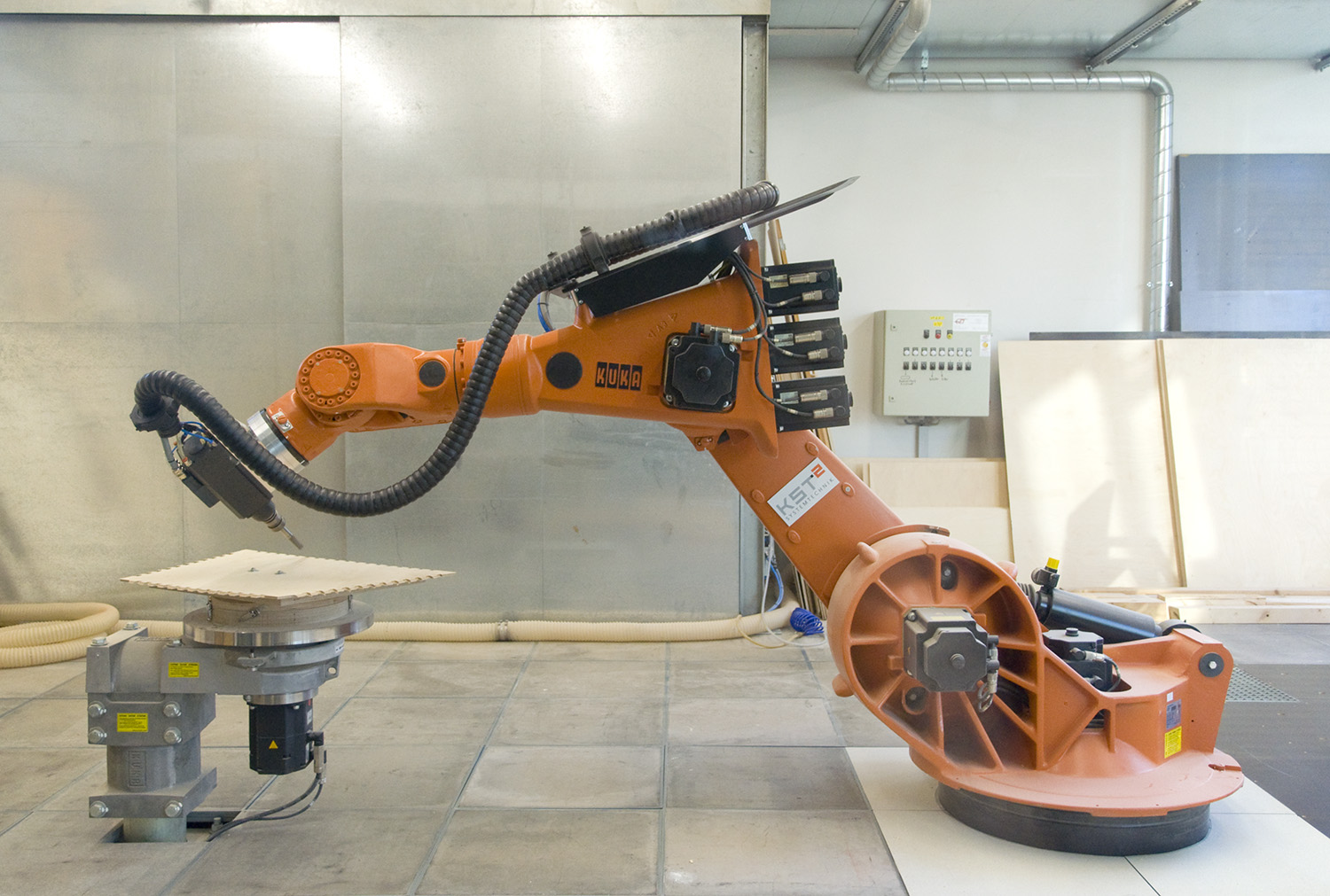
 “Robotic Fabrication” (Photography by ICD/ITKE University of Stuttgart)
On the future of his career in next 10–20 years
Young architects already learn how computational design and digital fabrication can influence architectural processes. . We have our own Masters program and we educate our students in that exact way. They basically employ the available technology for innovative fabrication processes. They already have a much different skillset than any classic architect or engineer. After working in this field for a few years there are a few possible areas that I could end up. Either I will be able to go into practice as an architect that understands and employs newest fabrication technology in the design process. There already some offices that offer this kind of knowhow. Or I will continue in research, science, and academia. With every research project we expand the possibilities of digital design and fabrication. While some of the technology that we develop might get adopted by the building industry in the next few years, new technology will be developed that will promise to make architecture smarter, more efficient, and more sustainable.
Interested in learning more about the future of fabrication? Check out Modelo’s recent interview with Brandon Clifford of Matter Design