

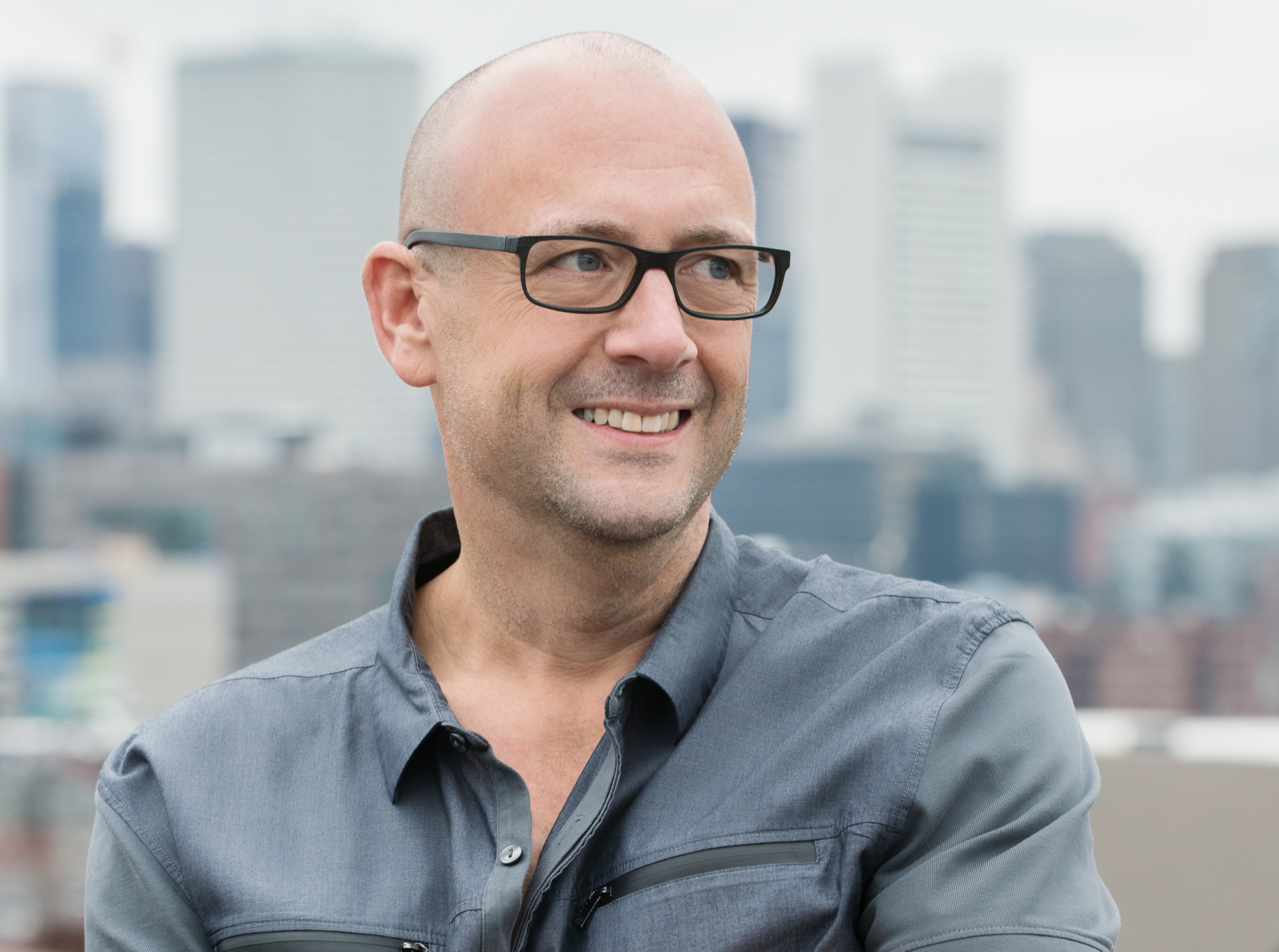
Chris Reed of Stoss Landscape Urbanism
Chris Reed is the founding principal of Stoss Landscape Urbanism. His innovative, hybridized approach to public space has been recognized internationally, and he has been invited to participate in competitions and installations in the United States, Canada, Europe, Israel, the Middle East, Taiwan, and China. Reed’s research interests include the impact of ecological sciences on design thinking, and city-making strategies informed by landscape systems and dynamics; he is co-editor of a recently published volume of research and drawing titled Projective Ecologies. Reed received a Master in Landscape Architecture from the University of Pennsylvania and an AB in Urban Studies from Harvard College. He is currently Associate Professor in Practice of Landscape Architecture at the Harvard University Graduate School of Design. Recently, Modelo had the opportunity to learn more about Chris’s unique approach and design philosophy.

On becoming a landscape architect
My entry point to landscape was cities—particularly nineteenth-century American cities, in which landscape played an important and formative role in the evolving shape and character and functioning of urban districts. Landscape was, in fact, part of a larger set of reform movements that were addressing public health issues, environmental issues, social issues-and doing it through a significant re-shaping of city form and function. Frederick Law Olmsted and his late-century contemporaries were inventing new parks and park systems that provided relief from the noise and congestion and pollution of the city, while simultaneously taking on environmental roles, hydrologic roles (river flooding, for instance), new social and recreational roles, and new connective roles—linking up parts of the city that were previously isolated, and utilizing new parkways and carriageways to structure entirely new neighborhoods to come. I was quite taken with these broader ambitions for landscape (landscape at the time was generally relegated to garden design or to regional planning absent design)—that it could take on social and political and ecological and infrastructural agendas, and play a much more significant and impactful role in the everyday lives of people and in the ways in which cities are imagined and made.
On discovering his voice as a designer
My education and training were spent (deliberately) oscillating between leading educators and practitioners who did not necessarily share the same design philosophies. With a degree in urban studies from Harvard and a year out at an architecture program at Columbia, I spent a year at Michael Van Valkenburgh’s office diving deeper into the discipline and medium of landscape. Following that I studied with James Corner and Ian McHarg at the University of Pennsylvania, where my work took on larger-scale landscape systems, environmental dynamics, and time-based strategies for social, environmental, and urban change. Coming out of school, I worked for George Hargreaves and Mary Margaret Jones on very large, complex urban landscape and urban design projects that involved the coordination of complex hydrologic and infrastructural systems and framed out a series of related building projects—and gave me the opportunity to see large-scale work negotiated through implementation and realized on the ground. All of these were quite different experiences, but they each had enormous impact on how I was beginning to think. At the same time, I discovered the power of physical form, and the way that physical form in the landscape engages the body—how it forces us to exert ourselves at one moment, and find a release at another. Through all this, I became interested not just in the sculptural effects of physical form, but in its performative effects as well. How is it that people could engage topographies and surfaces as instigators for social activity? How is it that water can engage landform and grade and produce different ecological effects? All of this, in odd and perhaps unintentional ways, shaped the way I think, the way I work, the way I practice.
On starting his own firm
I started the practice with a question and a research project.
The question was how landscape might play a more formative role in reimagining cities and metropolitan infrastructures, and how might we consider this in the context of contemporary global challenges of rapid urbanization, urban shrinkage, the effects of climate change, and various social and economic inequities that continue to emerge. In other words, how might we take what was emerging at the time in the discourse of landscape urbanism and put it to play on the ground, interacting with real clients, real sites, real implementation logistics, and real budgets?
On the other hand, the research project examined historic and contemporary models of expanded and innovative practices in design and engineering. Here I was interested in examples of folks who stepped outside tradition design roles, who might (through design research, for example) frame new project briefs, engage in political stage-setting for projects, or work to bring in additional constituencies to projects in order to expand resources and the issues and agendas that projects take on. At the same time I was interested in examples of how complex projects might spawn invention in terms of construction techniques and technologies, and how we might play longer-term roles in administrative, maintenance, and management regimes as projects play themselves out through time. This research project eventually emerged as the essay “Public Works Practices” that appeared in Charles Waldheim’s The Landscape Urbanism Reader.
Project-wise, we took a big and small approach. Small projects allowed us to test ideas (in exhibition and installation formats) and to establish a built body of work (from client-based projects) that would build our own knowledge, test engagement strategies, and demonstrate to future clients that we could execute projects in the public realm. At a larger scale, limited and invited design competitions allowed us to explore more complex ideas about landscape and urbanism and ecology and infrastructure—to speculate in the kind of urban contexts and at the scales we wanted to work. These competitions helped to establish the core of our ideology and our practice, and they allowed us to do bigger and more complex work than any client would be willing to give us (as a young and relatively untested team) at the time. It was important groundwork for the kind of projects and challenges we wanted to take on.
On specific principles he strives to adhere to
The work is quite varied right now, and it’s taken on newer social dimensions that add depth and richness to our initial obsessions with ecology and infrastructure. Common to all of it, though, is an interest in open-endedness, flexibility, and adaptability—but it’s an interest that is manifest in many different ways. Early studies at Bass River Park and Erie Plaza set up physical scaffolds for the playing out of ecological change and succession—spurred on by the ways in which we were re-directing and manipulating water flows. But these same ideas carry over into our thinking about social spaces—how projects in the public realm might be set up for people to use in many different and even unexpected ways. The Safe Zone garden at Metis was a first experiment, in which an abstract and undulating rubber topography allowed folks to explore and engage the garden on their own terms. These same interests extend to other projects like the Plaza at Harvard, where we’ve been interested in issues of human behavior, curiosity, and individuality—that we can set up public spaces to host a number of predictable or desired activities—and equip the space with the structural and functional scaffolds to do so—while simultaneously recognizing that people will adapt such spaces to their own agendas and uses.
These interests in open-endedness and adaptability extend to large-scale work, too—whether for growing cities or cities in the process of reformulating themselves with smaller populations. Here we think through flexible armatures for new urban districts, typological approaches to questions of use, and scenario-making: if this set of conditions arise, then this kind of formulation is possible—but if another set of conditions arise, the system can re-arrange and adapt itself to these new or alternate circumstances. Such strategies are opportunistic, and nimble, and they allow for many different futures, each of which abides by a set of common organizational and aspirational principles.
On recent projects that represent his unique approach
The Trinity Riverfront in Dallas, Texas, is demonstrative of a large-scale urban project organized around and by landscape, and built off the re-imagined stormwater infrastructure of the old river. Here we tune this monofunctional hydrologic stormwater system to new environmental and social uses, and in doing so create a new market for economic and urban development. The lush forests and water gardens are designed to withstand and adapt to both flood and drought conditions, and create a new dynamic, living and breathing landscape that will give rise to three new riverfront neighborhoods, closely connected to downtown. On the smaller scale (4 acres), we are re-making a campus quad at the University of Michigan into the new center of social life for the North Campus. Eda U. Gerstacker Grove will be a lush new open space that gives the engineers, artists, and designers in nearby buildings a place to simply hang out, chill out, and interact in ways of their own choosing. Like at Harvard’s Plaza, we’ve designed signature seating—here long seatwalls—that change from a curb to a simple bench to a full seat and back again, in order to give folks choices and flexibility about where and how they choose to sit on any given day. We’re also interested in creating connections between technology and environment and people, and have designed an interactive lighting feature in five large stormwater gardens that will flicker every time water enters the system—thereby bringing sustainability to life in the everyday experience of the place.
On his design process
It’s quite exploratory, open-ended, and iterative. Often we begin projects on a number of parallel tracks: what kinds of programs or activities might we imagine? what are the untapped resources available to use on or near a particular site? and what are the organizational logics and formal approaches to intervening on site? Often we’re working with teams of experts to help identify key issues from a wide range of disciplinary perspectives; our job is to find ways to bring those agendas together, allow them to collude in creative and inventive ways. We also ask a lot of questions: what if the project did this? or what if we did that? How might we explore new ideas, organizational principles, and fabrication methodologies through new software applications, modeling applications, and technologies? How might we allow a project to open up a set of inquiries (both conceptual and highly pragmatic), rather than simply answering the questions we’ve been asked to take on?
On the future of design in the next 5-10 years
Impossible to predict! Food supply, climate change, social and environmental justice. Innovation, technological change, cultural evolution. Whatever it is, the work must insist on being ambitious, on continuing to develop and evolve a cultural agenda at the same time it might take on these pressing problems. How can we be inventive yet pragmatic, aspirational and imaginative while simultaneously rooted in the realities of the people and things around us?
On advice he would give his younger self
Have fun, smile, and get away from work more—in order to be totally energized to dig in again when you return. And be open to taking a few more detours along the way—you’ll never know what might become of it!