

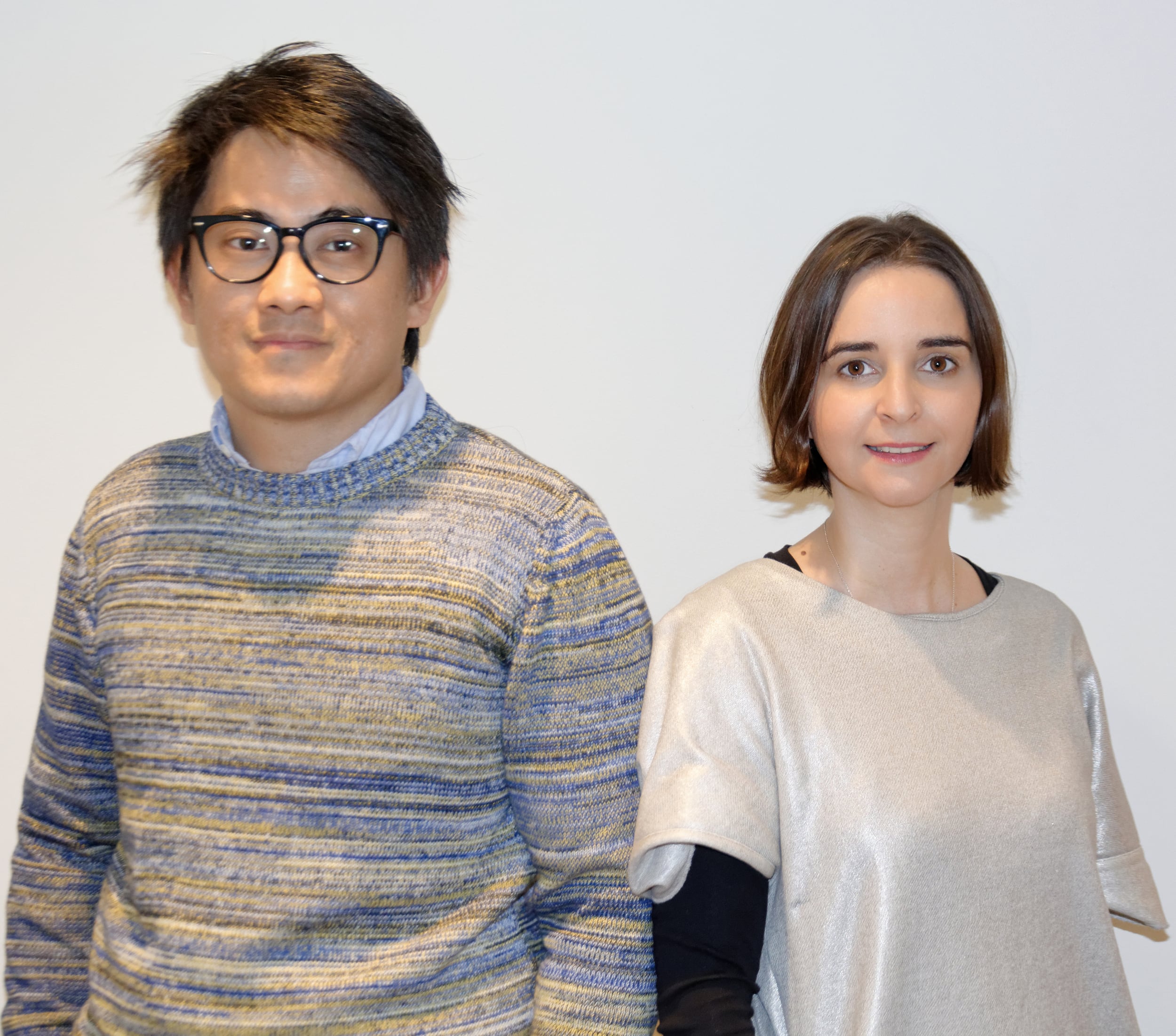
Leire Asensio-Villoria and David Mah of asensio_mah
asensio_mah is a multi-disciplinary design collaborative active in the design of architecture, landscape design, masterplanning, interior design and installations. asensio_mah was established by Leire Asensio-Villoria and David Mah in 2002 and has been involved in a number of projects in Asia, Europe, North America and Australia. They have published and exhibited their work internationally. Leire is a registered architect in Spain and David is a registered architect in the UK. Both David and Leire are teaching at the Harvard University’s Graduate School of Design. They have both taught at London’s Architectural Association School of Architecture, Graduate School’s Landscape Urbanism programme, and at Cornell University’s College of Architecture, Art and Planning. Recently, Modelo had the opportunity to learn more about Leire and David’s unique approach and design philosophy.

On becoming architects
David: When I was growing up I did have some family friends who were architects. There was one family where both parents were running an office. So I remember being over at their house — they had a home office — and you could see a lot of evidence of their practice around the house. A lot of those things resonated with me. I was already very interested in design and art. It offered a focus for that general interest in design. Somehow the spatial results of dealing with architecture seemed compelling.
Leire: I had no direct personal exposure to architects; I don’t come from a family of architects but I was always drawn to art and engineering. I remember, while at the school, I used to love the classes that were more related to descriptive geometry and drawing. I remember in high school, when you start to lean towards one profession or another, I became curious about architecture. I loved math, which was important if you wanted to access university studies for architecture. I remember buying my first architectural journal, while at high school, just to see what was out there. I was taken by the work of Rem Koolhaas (whose work was featured in that journal) even before I entered architecture. I went into architecture a little bit blindly in the sense that I didn’t know exactly what to expect.
On discovering their voices as designers
David: Typically when you’re going through undergraduate architectural studies, there’s a period of training where they expose you to people who are considered important figures, like Le Corbusier and Palladio, for instance. You have to go through the history of Western architecture and you have to be exposed to the discipline. But in many ways a lot of the moments where I figured out that there was a particular line that I’d like to pursue beyond what’s expected of you was when I started to realize that there’s a legacy, in design, of investing in systems. I learned how systems can actually become a guide for how you develop architecture and how you develop responses to space and even design languages. There’s a very clear problem-solving aspect to it but there’s also an ability to generate a language or aesthetic from it as well as ways of engaging different audiences together with different considerations or influences.
Leire: It’s exactly the same for me because my sense is that it happened to us around the same time. I studied architecture in both Spain and the UK. During my years in undergraduate education in Spain, every year you have your new idols or new people you’re interested in because you’re learning along the way. Perhaps we were both introduced at the Architectural Association to a lot of ways of working through systems and understanding how to negotiate across disciplines. This is when it became less disciplinary in the sense of being completely linked to architecture with a capital A, but being able to work across different professional and disciplinary knowledge. Somehow the need for a dominant influence or a reference architect started to fade and you start to be open to a lot of different concerns and influences. You no longer were obligated to pinpoint one specific name or a lineage.
On starting their own collaboration
Leire: Part of it was accidental, part of it was not so accidental — it was really ambition. Like any young architect you start off entering competitions and entering into everything that’s out there to try to get the opportunity to build something for the first time. In that way we did get a few small opportunities and we did get the chance to build a few installations and that’s how it began.
David: When you come out of school, you can be extremely ambitious, so you think; “I’ll work, but at the same time I’m also starting my office in parallel.” In reality, it’s difficult to manage both. When a house commission came along it was an opportunity to be more concrete. In that case Leire actually took on the role of being fully dedicated to working on these projects.
Leire: We were already teaching as well at the time which was helpful. That’s something that we started doing a number of years after we graduated and was extremely positive because you start to do a lot of investigation through academic research and working with the students as well. We started a healthy exchange between how much you can bring to the studio from professional experiences and concerns and how much you benefit from the depth of discussion and thought possible in the studio. That gave me the opportunity to leave my other job in an office and to be more dedicated to our work. It also allowed me to develop or sharpen new tools and approaches. I remember with the customization of the facade panels of a house, for example, we had done some digital fabrication work in an academic setting and had first-hand experience with these tools. Without the possibility of investigating some of these issues in academia, it would have been difficult to motivate and gain the confidence of the contractors based in the region (who had never done something like this at this domestic scale and within such a tight budget).
On principles they strive to adhere to across projects
David: You also have to be careful not to be dogmatic. We can try and have a general set of interests which frames everything. However, the negotiation and the serendipity that comes from having different experiences helps to shape and inflect your approach. For us, while there’s a core set of interests in systems, it’s not necessarily that we’re always imposing ideologically on everything we do. Whenever we have a particular project or a new set of experiences, these can also shape your interests as well. In our case we try to balance between having interests that guide us with being flexible. We’re also mindful not to be super eclectic and doing whatever randomly. It’s a balance and it’s hard to categorically articulate what that balance is because it’s a combination of intuition and rigor.
Generally if you’re interested in systems it also means that you might not be bound exclusively to specific disciplinary concerns. In many ways a systems approach can be applied to landscape concerns, to architectural concerns and to urban design concerns and work across all these different scales and fields. It would be great if you have a consistent approach that’s able to negotiate all of those different concerns. For us, understanding and identifying the systems within these different areas is something that motivates us whereas a lot of people may be bound to a very particular set of disciplinary concerns.
Leire: Part of our interest is to always have a strong awareness of the repercussions of architecture and understanding the disciplinary concerns in other realms like urban design, landscape, and how the influences from the other fields also affect the way that we produce our architectural schemes. This is not so accidental. During my training in Spain, you were not necessarily limited by the disciplinary boundaries between landscape, urbanism, and architecture. You were taught all of this during the years you were at university and at the time I was trained we did not have landscape architecture as a separate professional category in Spain. Those boundaries between the design disciplines were not as strong in Spain as my experience when I moved to the UK or the US.
On projects that represent their unique approach
Leire: A good example may be the Q House project, in the context of Spain, where incidentally, every single house has to be done by an architect. It’s within a development which was on steep topography but the impulse from every single architect, without exception, was to flatten the land within the parcel and just consolidate the building volume to be as big as can be. The landscape is whatever is left over. Because we had this interest in landscape, we adopted a different approach where we worked with the steep grade of the site. That forced a change in the typical typology of the consolidated flat parcel and the site became something which was terraced, with the building form itself having to negotiate these different levels. As a result the organizational logic of the house changed considerably. It wouldn’t be a house organized vertically in discrete floors but we actually had half-floors or split levels. That creates a different living arrangement and different set of experiences and a much more deliberate relationship to the outside. You have your small yet deliberate outdoor spaces or terraces versus simply whatever is left over.
When you look at the floor plans of the adjacent houses versus ours in terms of the ground coverage, our scheme has a smaller footprint yet the square meters are the maximum allowed like the adjacent houses. In other words you gain a lot more from the outdoor living as well. Because of the way in which we had to negotiate with the topography using a lot of landscape tools, you gain a lot of vantage points of the territory. This is something that was integrated inside the house, not only the views from inside to outside but across rooms to the different levels. You create a very different type of lifestyle and spatial experience inside.
David: Another project is a series of garden installations that we were invited to do in Canada. The way a landscape architect may typically approach this is to firmly place the garden within the place itself by planting or embedding elements directly into the ground. We were thinking about something that would actually be constructed as autonomous pieces and would be able to be shifted around, rearranged so that you can create different conditions and also reuse them in different contexts. We took it more from a product design approach. We thought what we should produce is something more like a system of products, but the way that you accumulate, arrange and aggregate these products might still be able to create their own particular places and spaces.
We understood that the resulting formal configurations had a strong effect in creating a specific microclimate. This resulting installation was a series of planters that can be arranged to make a larger surface and depending on the exposure and orientations, you create a spectrum of areas which range from exposed and dry to shaded, and moist.
Leire: At the same time, there was also an intention of creating a certain degree of ambiguity as to how the visitors will interact with it. It was fascinating that something that was not so pre-programmed became completely appropriated in many unexpected ways by the visitors. This issue of the microclimate had an effect as well on how people will approach and engage with it.
The idea of the garden as something that could be constructed from reconfigurable elements was taken even farther in the second version of the garden — a lot of these garden installations are temporary and when the event is over, everything is demounted and thrown away. The gardens can even involve planting mature trees and vegetation, which are simply shredded when the event is over. We thought that was not a great strategy, so we decided that the idea of pre-fabricated and reusable pieces taken all the way to the vegetation itself, made a lot of sense. In this case, even though the second installation was only up for a couple of weeks, the moss itself could be taken back to the green-house and all the components of the installation could be re-used in another way.
On the aspirations for the firm
Leire: We have had a couple of years where we’ve done interesting research within an academic context. They’re been extremely helpful for us to not only get acquainted with new tools but to expand the knowledge in some of our core interests. Right now we aim to move back into more projects that allow us to apply some of these new acquired knowledge that we have done through academic research.
David: We just completed a research project here with the Harvard GSD HAPI group related to studying the effect that public health concerns may have on configuring the neighborhood scale of the built environment. We were looking particularly at the Chinese context and were in charge of developing templates and prototypes that embed health concerns as the main considerations in neighborhood design. We’ve been using computational design tools both in terms of analysis and design generation. These kinds of projects are great way to expand the scope of knowledge when approaching the design of the built environment. It can’t help but influence your own design practice.
Just around 2005, when we started teaching in the Landscape Urbanism program at the Architectural Association, we were developing the house project. The influence of the research on landscape concerns had a huge impact on the actual development of the project. Certain experiences such as those enabled by longer sustained academic research have the capacity to enrich your own design approach.
Leire: Issues of lifestyle have always been of interest to us. Even with this last research on public health, issues of lifestyle became intrinsic.
On the future of architecture in the next 5–10 years
David: There are a lot of larger issues that are currently framing wider public debate, which can’t help but influence what we do in architecture and design. If you look at the aging population for instance, we’re talking about something that’s unprecedented in the Western world and in China. In China, we’re talking about 30% of the population being over 60 or 75. These concerns will start framing some architectural, landscape and urban design discussions. There’s also a big discussion about inequality, sustainability and resilience that will have an effect. You can see it in a shift in focus from glamorous museum projects to discussions about social housing or the reuse of old industrial buildings, for instance.
The role of technology is something that also has a big influence as well. Digital technology is a given now, but it’s also exponentially increasing the ways in which we need to understand how it affects the design and delivery process. We have to come to terms with it and leverage it.
On advice they would give their younger selves
Leire: The thing is that I don’t regret any of the experiences I’ve had. I think they’ve all been fulfilling- even the ones that at the time I did not enjoy that much. In the long run, they’ve been helpful in shaping other things along the way. It’s about following your instincts and the commitment you have for the profession. At other times I’d say be patient. Perhaps in some contexts that I wasn’t enjoying at the time, I realized later that I did get a lot from those experiences. In general, the good and the not so good experiences have contributed to where we are now. Sometimes we can be too concerned with planning your career with ten or twenty-year plans but good opportunities can come unexpectedly, so I gave up planning absolutely everything long ago.
David: When I graduated, London was a 1 or 2 year deal for me. That ended up being a great 10 years for me. I could say the same about the US as well. Consider being flexible and open to different opportunities.