Archelectic: Manifold Pavilion | Modelo Blog Series
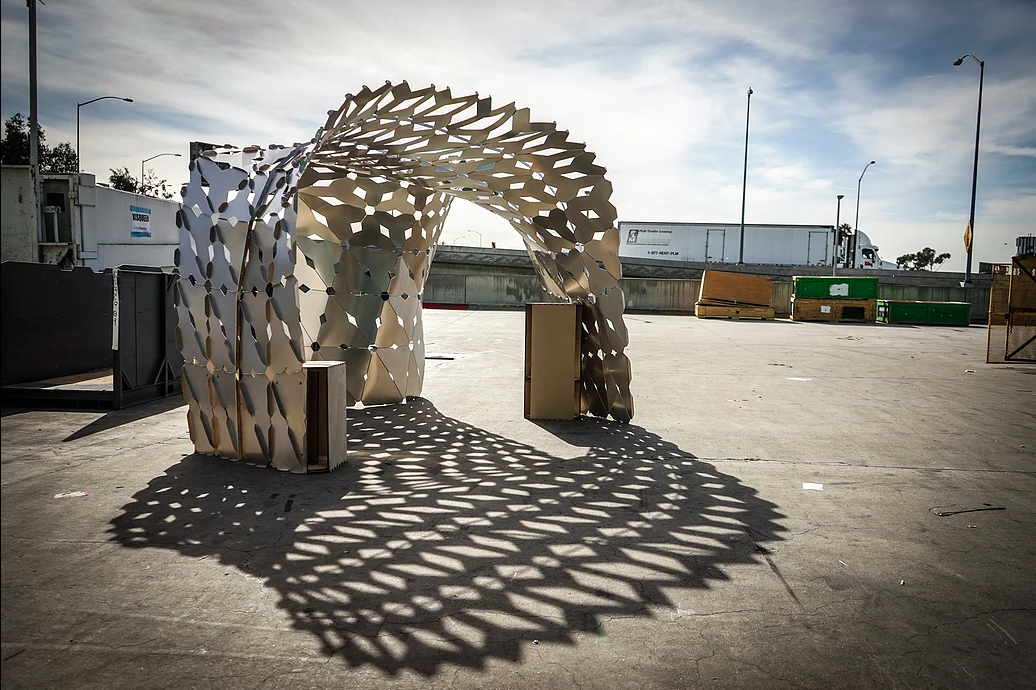
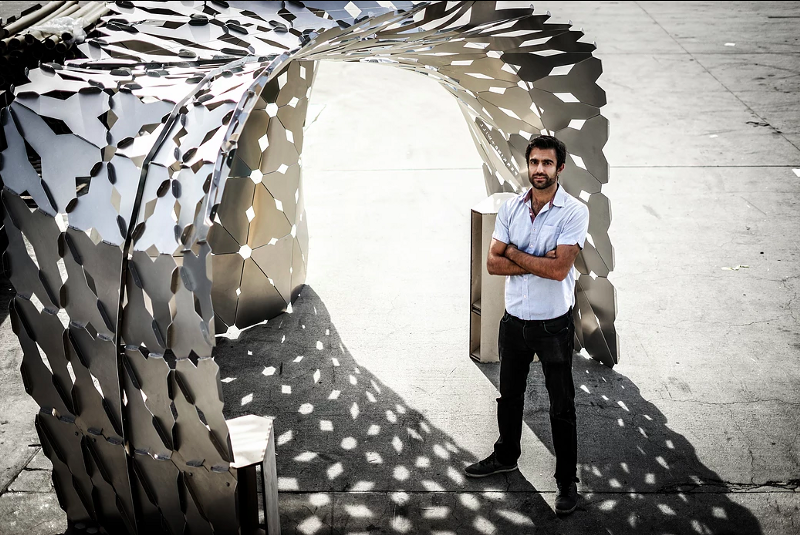
The Minafold Pavilion is an exploration in material performance. Rather than treating sustainability as a checklist of material choices, this canopy poses the question, “Can the properties of a single material be maximized to achieve minimal waste and compose a visual performance?” The pavilion encompassed a 10x10x8’ volume, while only weighing 100 lbs. The Minafold Pavilion was asked to accomplish much with very little.
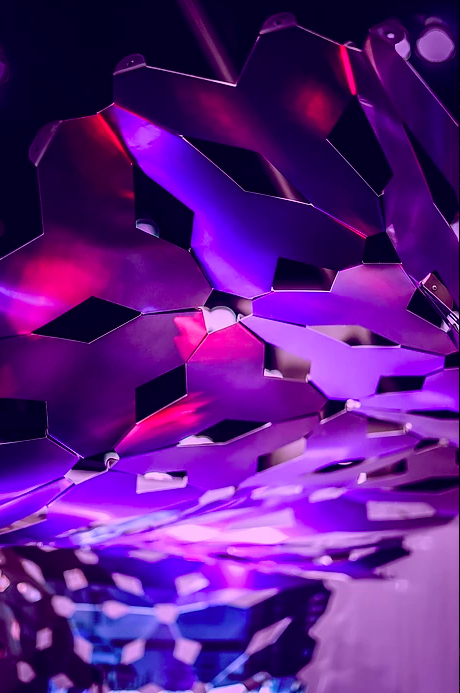
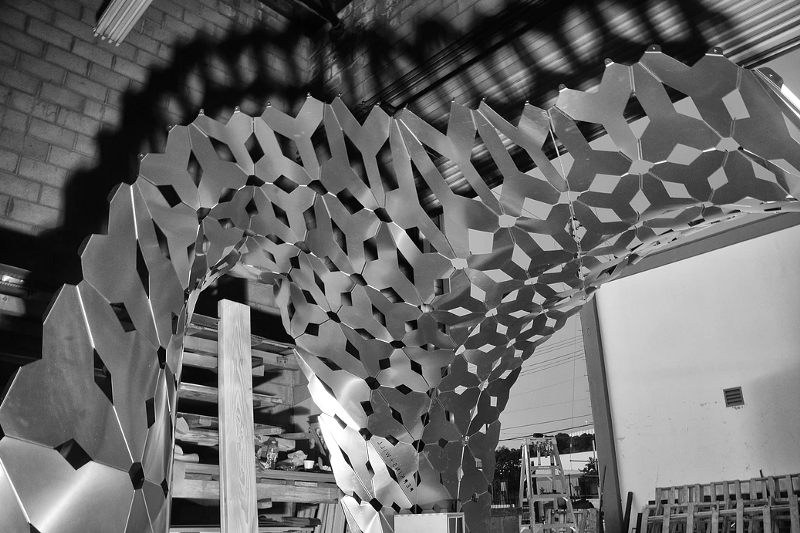
This structure removes traditional columns and beams and uses the curvature of a minimal surface, designed using the physics simulation software, Kangaroo3D for Grasshopper3D. The Minafold Pavilion uses 177 square feet of recycled sheet material (18 Gauge Aluminum) and turns it into a self-supporting structural element through bending (at the macro scale) and folding at the micro scale. The surface is then triangulated and perforated with a variable size aperture. The perforations transform from small holes at the base, where stiffness is required, into a lattice at the top where flexibility is needed. Each of the 192 unique panels is laser cut with holes and labels built into the algorithm.
A brake form is used to fold the connection tabs where a rivet is driven through to join them. All aspects of the design were parametrically controlled from the location of rivet holes to the laser-etched connection labels. The construction process was streamlined by a “paint by number” catalogue system that made it easy for someone to build without prior experience, or even an understanding of the final design intent. A 3D file and 2D drawing of each component was provided on site to create a set of easily-understood instructions. The Minafold Pavilion invented a construction process that re-thinks traditional notions of lightness, sustainability, and structure. The Pavilion made its debut at the 2016 Greenbuild Expo in Los Angeles on October 6th, 2016 and was warmly received by attendees, gaining its own following with the hashtag #Minafold.
Architecture: Perkins + Will
Project Designer: Joseph Sarafian
Coordination/Planning: Sandra Cervantes, Yuriva Bueno
Sustainability Coordination: Eric Brossy de Dios, Lorraine Polanski
Fabrication: Ampersand Contract Signing Group
Videography: Nathan Ingalls
Photography: Carlos De La Rosa Jr.
Build Team:
Hrant Varozian, Eric Brossy de Dios, Davon Johnson, Oliver Aus Der Muhlen, Anish Reddy, Justin Brechtel, Tim Pettigrew, Andrew Tsay Jacobs, Sandy Ghaly, Jorge Mutis, Aram Hernandez, Kylie Gaines, Mohsen Ghanbari, Eric Aukee, Doug Mayer, Devika Tandon, Jessica Radparvar, Abby White, Tina Giorgadz, Joseph Sarafian
House in Koidu Village (Photograph by Tõnu Tunnel courtesy of Kadarik Tüür Arhitektid OÜ)
Design: Kadarik Tüür Arhitektid OÜ
Client: Tarmo Hillep
Location: Koidu Village, Saue Parish, Harju County, Estonia
Structural design: Printsiip OÜ
Builder: Villi Kirjanen
Gross useable floor space: 157,7 m2
Lot size: 2079 m²
Start of work: 2014
Completion of work: 2016
Structure in: stone and wood construction
Photographs: Tõnu Tunnel
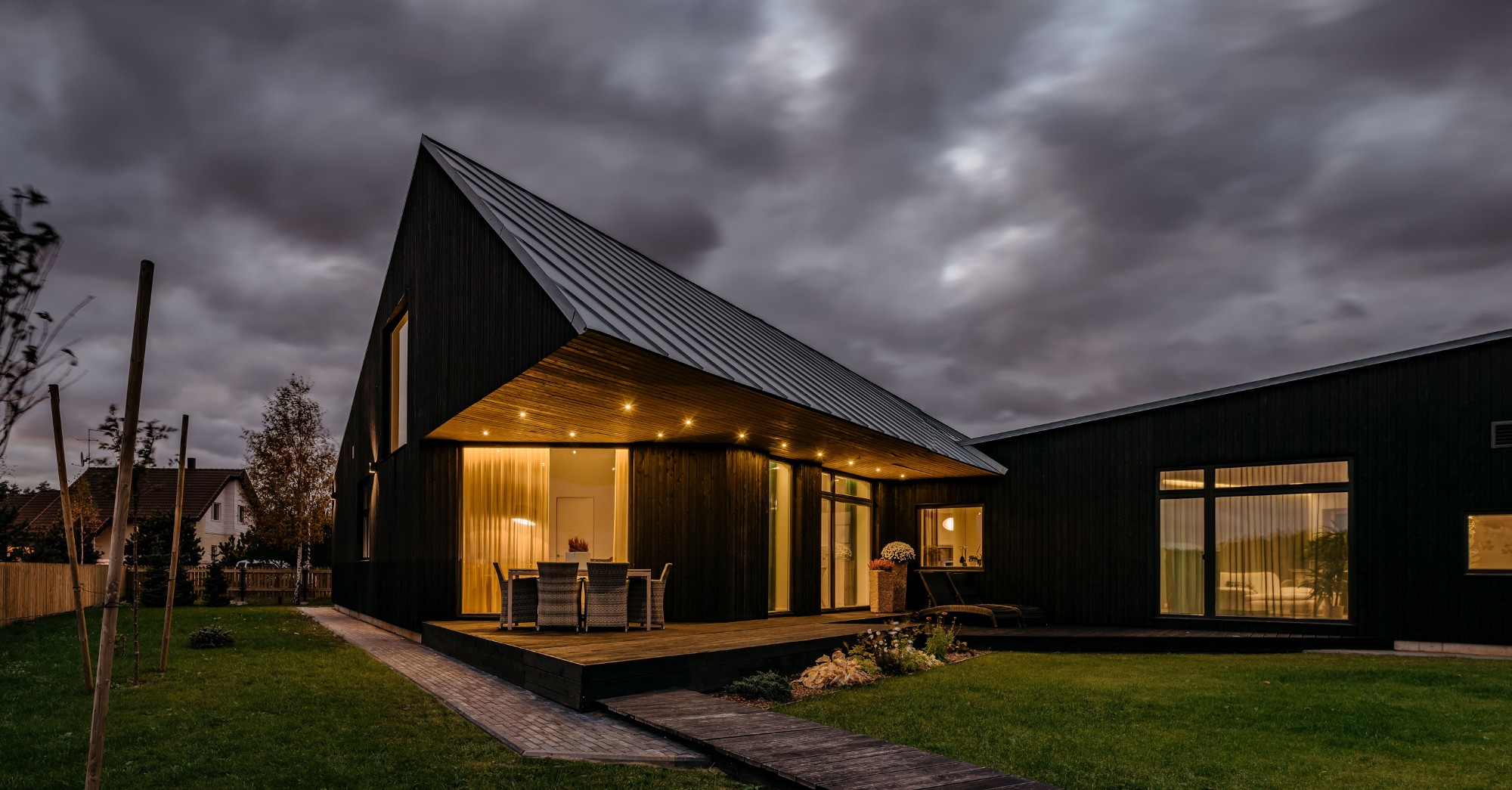
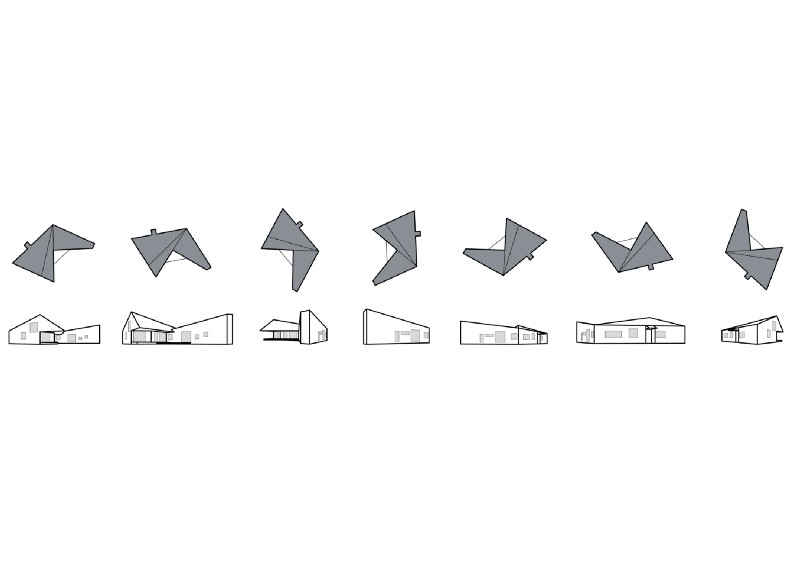
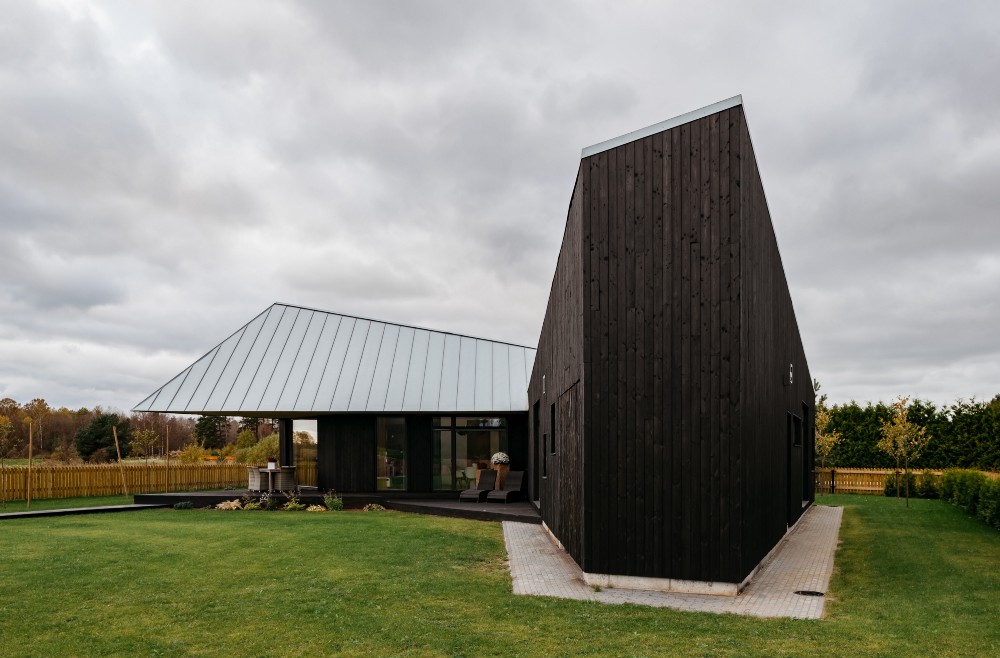
One story high building is located in Saue Parish Koidu Village in a private housing area. The geometry of the house is inspired by the plot itself and the movement of the sunlight to catch as much warm southern and western sunlight as possible. The building is a shape-shifter offering different views from every angle.
The main building was erected on the western side of the area while the grill house stands on the east side of the plot inside a small hill and acts as an echo of the main building. Between these two volumes an inner rectangular courtyard is created with golden ratio proportions. The landscape protects the yard from the traffic noise and offers privacy.
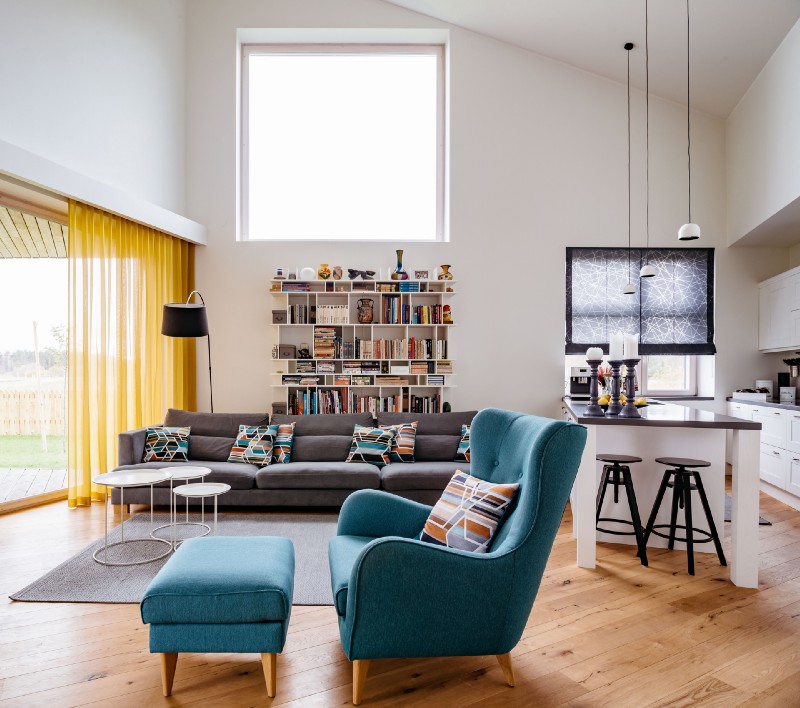
Spacious living room, with a height up to 6 meters, is located on the western side of the building and opens into both south and west. The livingroom is tightly connected with the terrace outside. The shape of the terrace is also created to follow the sun and catch as much southern and western light as possible. There is a chance that a neighboring house will block the western sunlight in the future. To maintain the access of the valuable evening light into the living room, a special sun window is created higher from the eye level.
Main parts of the constructions are made out of stone and laminated wood. The facades are covered with painted larch wood.
Design Team- Luke Prifogle + Dane Stokes
PennDesign 2014
Studio Instructor- Hina Jamelle
Structural Adviser- Daniel Brodkin | Principal ARUP | NYC
Structural Adviser- Matt Jackson | ARUP | NYC
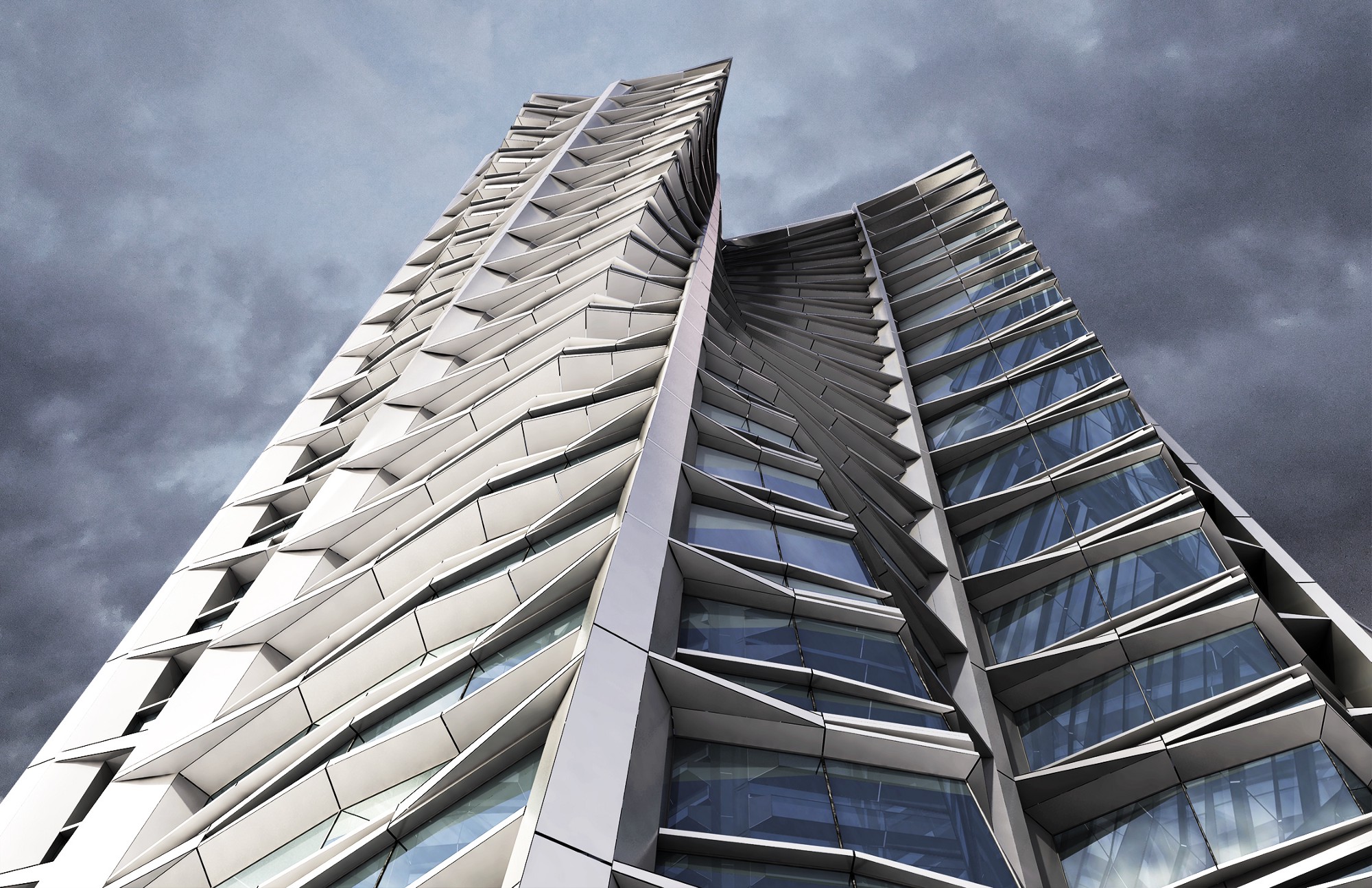
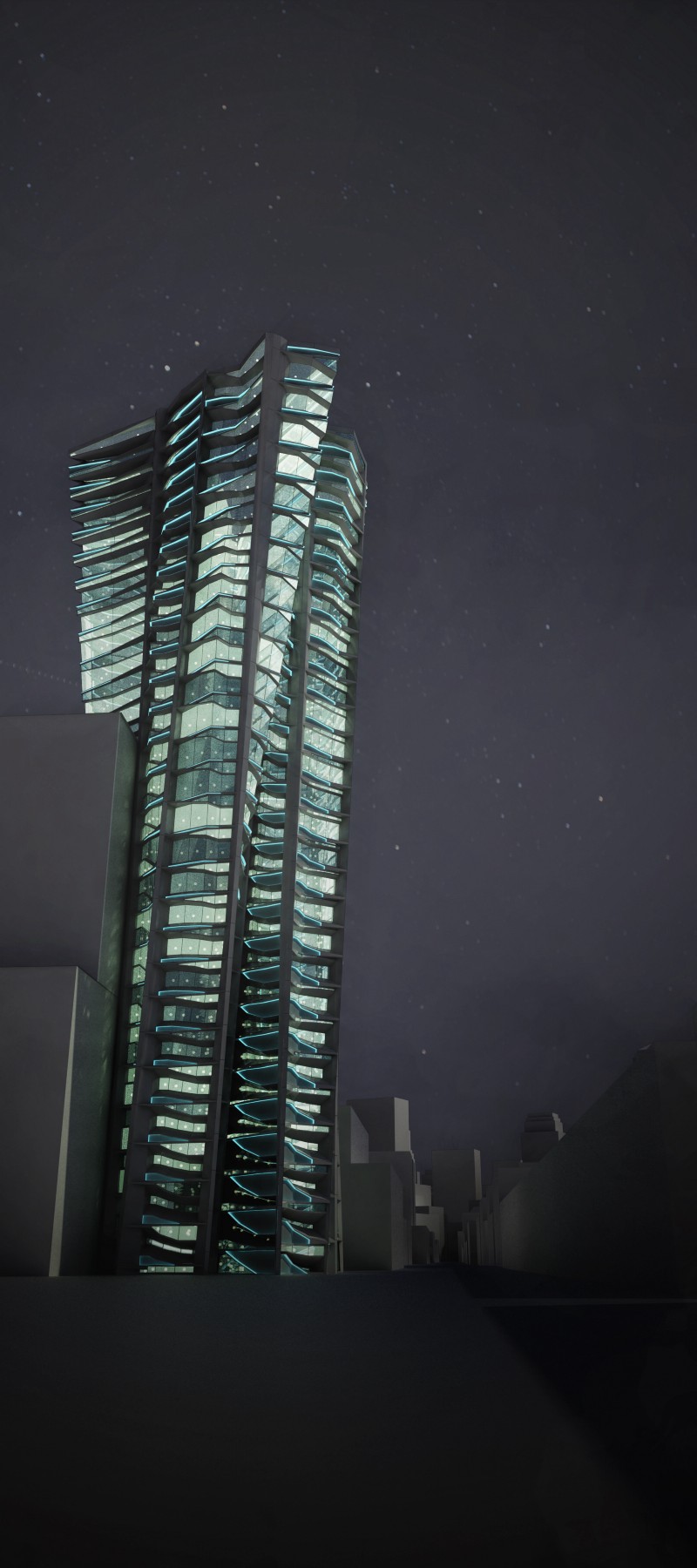
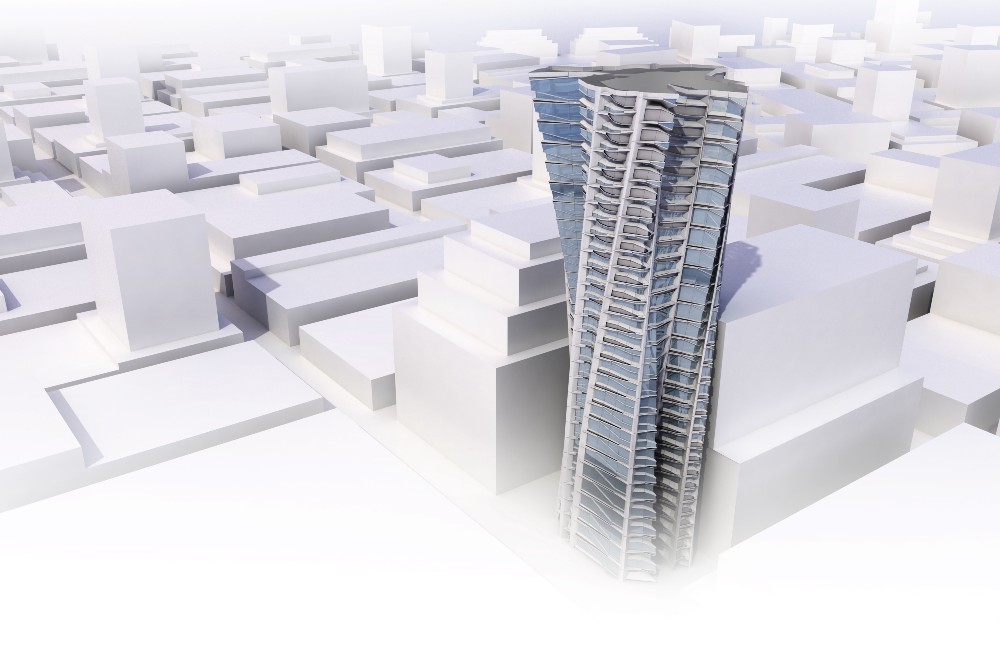
Fractured Veins is a mixed use tower located in West Chelsea that holds retail, commercial, residential, and luxury that combines structural elegance with striking aesthetics. Through iterations of formal and diagrammatic transformations, based on the state change of metallic crystals in meteorites, a formal driver appeared.
Fractures in the form created structural lines up the building. This allows for a structural system that allows the form to play in between the veins of the building.
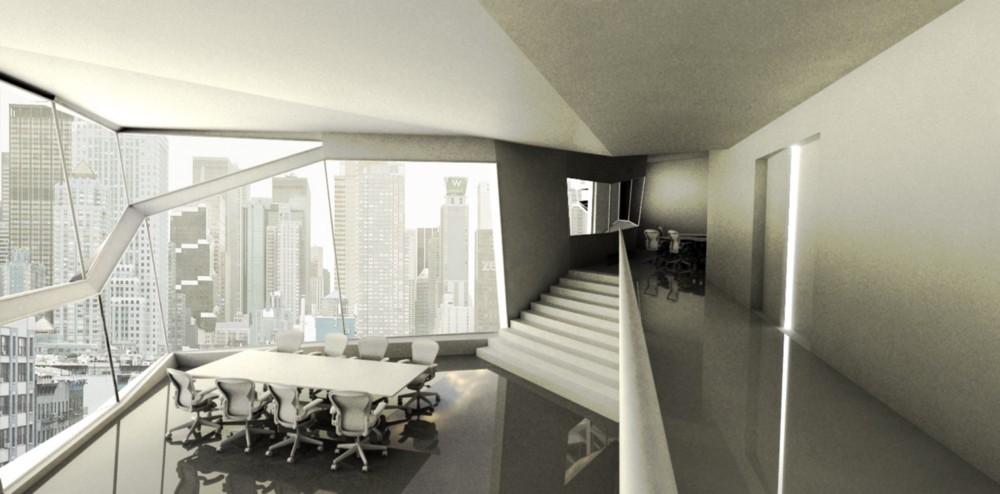
The transition of program from commercial to residential takes place along these fractures, mixing the program of the building in a new way. The veins respond to these transitions, along with the facade. The fractures cut into the building, creating a relationship of facade to interior of the building.
Design Manifestos: Sarah Hempstead of Schmidt Associates
Sarah Hempstead (Photograph courtesy of Schmidt Associates)
Sarah Hempstead is an expert at combining inspiration and perspiration alongside owners to deliver signature solutions with a purpose. As the CEO of Schmidt Associates in Indianapolis, Indiana and the Principal-in-Charge of the Higher Education Studio, she brings her master-led approach to each project and to the many happy owners of those projects.
Sarah understands that building trust comes before building consensus, and that there isn’t a building without both. That’s why she leads her team to collaborate within a framework that’s proven to produce results on time and on budget. That’s why owners and stakeholders love working with her and following her direction. Modelo spent some time learning about how Sarah got started at Schmidt Associates and about her current role.
On becoming an architect
I had taken every math class offered at my High School. One of my favorite math teachers suggested I try one of his other classes, Design & Drafting. I loved it, and he recommended I become an engineer. I researched it and decided I wanted be an architect. He said I should be an engineer because they have better hours and make more money. I started touring architectural and engineering schools, applying, and receiving my acceptance letters. It looked like architects were having more fun, and the rest is history.
On discovering her voice as a designer
I’m not a disciple of one type of style per say, what influences me is thoughtfulness — what does someone need a building to do and how the piece fits into a larger puzzle. How does it need to work for them to succeed? Every project can have a sense of wonder and delight, every project can enhance mission and build community — with a thoughtful sustainable approach to design.
On joining Schmidt Associates
I accidentally ended up at Schmidt Associates. My fiancé, now husband, was working here and said, “you should meet Wayne (our Founder), you would really like him.” We met, I really liked him, and thought I could learn from him. So I came here and 15 years later I am now CEO.
Since joining the firm, I’ve had the opportunity to push design further, while still maintaining a sense of Midwestern sensibility. We can push the box from both the architectural and engineering sides, while meeting the needs of the clients. Culturally, the understanding the public has of design has shifted, which is a great opportunity to go even further.
On specific principles she strives to adhere to
Projects need to be mission driven and form must follow function. It’s been said so many times, it is almost boring, but it is still true.
Schmidt Associates functions out of the premise that our designs aren’t our building. They are our clients building. Acting through Servant Leadership, we lead our clients through a process to meet their needs. This includes thinking holistically about the life cycle of the structure from the architecture to the engineering and the buildings sustainability. The building can’t just meet their needs today, but needs to look into the future.
On her role as CEO of the firm
As we move into our next chapter as a firm, our core DNA remains exactly the same. We remain laser focused on excellence and service to our clients, our community, and to each other. That said, we are faced with a period of enormous opportunity to build on a strong foundation of unparalleled expertise and service. We are going to capitalize on this opportunity by:
Fostering new design and ideas through a renewed commitment to excellence
Expanding the firm’s service offerings
Growing our client base
Growing our geographic reach
Growing our people through a renewed commitment to training, culture, and expanding opportunities for merit based career growth.
On projects that represent the firm’s unique approach
Yes, for us the drivers of design are context, mission, and stewardship. We start each project by asking the client what their mission, vision, and goals are for the project. We push the envelope. We work to make the process collaborative with a result that delights and serves the mission. Some recent projects that represent this include the following:
Illinois Fall Creek Center (Photograph courtesy of Schmidt Associates)
Illinois Fall Creek Center (Old St. Vincent hospital)
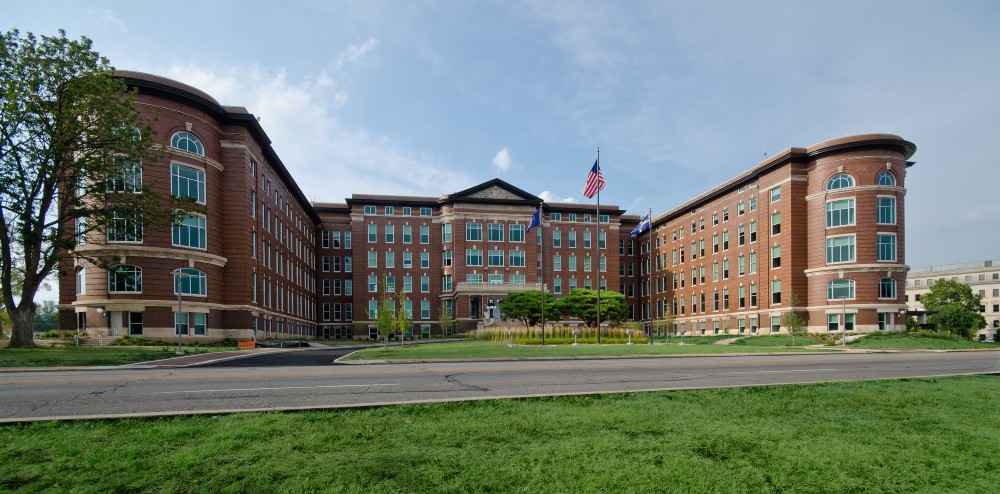
The Illinois Fall Creek Center (Old St. Vincent Hospital) consisted of an incredibly complex restoration, renovation, and addition. Originally built in 1911, the building had long been abandoned when it was given to Ivy Tech Community College by the City of Indianapolis. Working with the college and the community, Schmidt Associates developed a plan to restore the historic southern facade and central stair to renovate 50,000 s.f. of the existing building, demolish the central and northern building bays, and create a new modern 180,000 s.f. addition — contrasting the historic façade.
The award winning result serves as the campus center including classrooms, labs, a cafeteria and kitchen, as well as student commons and community meeting rooms. A new elevated pedestrian bridge connects to an additional historic structure — the AUL building — Ivy Tech’s first academic building on the Fall Creek campus.
“Schmidt Associates developed a creative design solution that preserved more of the Fall Creek building and saved us more than $2,000,000 in costs. The result has been lauded by members of the college community, as well as many outside constituents.” — Richard Tully, Assistant V.P. for Facilities Planning
Marian University, Evans Center for Health Sciences (Photograph courtesy of Schmidt Associates)
Marian University, Evans Center for Health Sciences
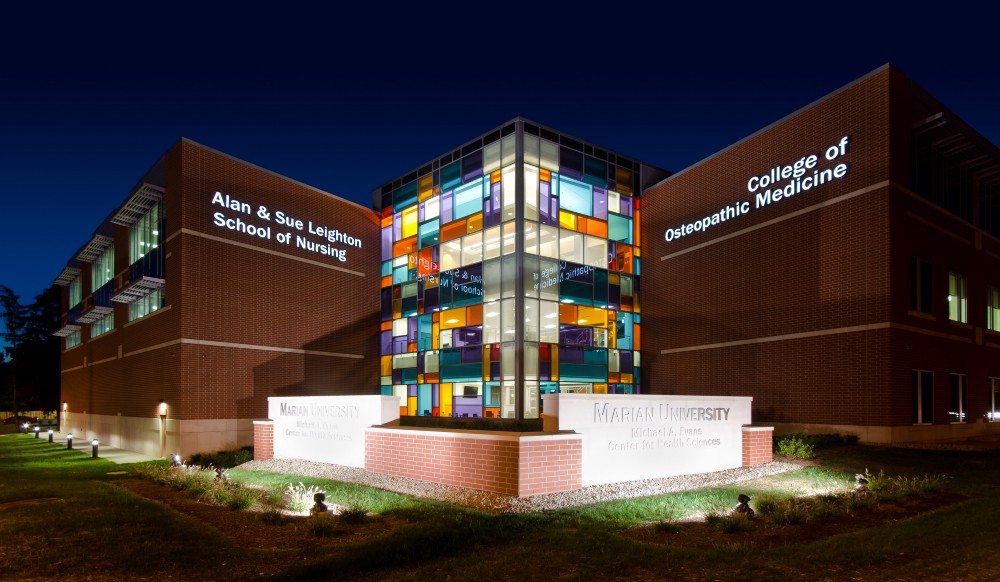
When Marian University decided to start the first Catholic College of Osteopathic Medicine (COM) in the country, they called on Schmidt Associates to lead the design process. Balancing the needs of the School of Nursing (the facility’s other key occupant and one of the most respected programs currently on campus) and the needs of the new COM was an exercise not only of building programming, but of academic programming. Ultimately, the facility was designed around a shared culture of respect and shared experiences for nurses and doctors learning together. The $49,000,000 new facility is home base for 600 medical students, and includes labs for anatomy, osteopathic manipulation, practice clinical labs, simulation labs, lecture halls, classrooms, and offices. The project achieved a LEED Gold designation. The overall design — strategically situated on the very edge of campus — enhances the architecture of Marian University and its visual presence to the City of Indianapolis.
Hoosier Energy Headquarters (Photograph courtesy of Schmidt Associates)
Hoosier Energy Headquarters
Hoosier Energy Rural Electric Cooperative, Inc. identified the need for a new headquarters building, through a year-long strategic master plan effort that would pay particular attention to energy usage and consumption. Schmidt Associates produced a plan accommodating Hoosier Energy’s unique business model and designed a simplified prairie-style structure located in a heavily wooded site. The prairie elements include long horizontal roof lines, the use of brick masonry as a means of exterior structural expression, and windows in darker colors which visually recede, giving the roof a floating effect. With LED lighting, geothermal heating and cooling, and natural light illumination in work spaces, the building will consume nearly 45 percent less energy than a comparable building of this application and size. The resulting building is LEED Gold Certified, delivering on Hoosier Energy’s goals for a headquarters designed around energy use and consumption.
Regenstrief Institute (Photograph courtesy of Schmidt Associates)
Regenstrief Institute
The Regenstrief Institute provides research, development, and education to further health care deliver in their new 80,000s.f. facility anchoring the recently improved IUPUI healthcare campus entrance. The Institute had several goals when design began.
Demonstrate the company’s mission — “to make a difference in healthcare.”
Create a facility Sam Regenstrief would have been proud of — a facility to define his legacy in healthcare and the city.
Encouraged cross discipline collaboration and partnership within the institute and with key external partners.
To fulfill the goals, the facility integrates branding and information sharing — with robust static and digital storytelling throughout the building. Department specific layouts met the unique needs of each group, with institute wide collaboration spaces conveniently located next to the main entry. Small group focus areas and collaborative environments on every floor allow for creativity and ultimate workplace flexibility. All 250 researchers benefit from the location — between key partners in a campus environment — allowing easy access to external partners and enhancing the institutes ability to advance medical research.
The 4-story brick and metal panel structure complements both the historic brick campus and the new modern Eskinazi Hospital.
Sustainable features include:
construction on a brownfield site
walking accessibility to amenities and public transportation
white/green roof
low water use fixtures
high efficiency mechanical system
storage and recycling areas
natural daylighting to over 75% of the building.
On her design toolkit
Schmidt Associates has so fully integrated Building Information Modeling (BIM) into our design process that we have altered our physical office layout to maximize the software’s capability by creating project design labs. These labs accommodate our inclusive process of bringing each of the building systems through design and development simultaneously (rather than allowing architecture to finish, then engineering, etc., in a lineal fashion). Each lab has multiple large, flat screen monitors between work stations, allowing visual access to the physical impact of each building component as it develops. The process is an ongoing and immediate development of design concepts. It allows for easy visualization of the reality of building support systems and resolution of issues.
Using BIM, we are able to maximize our ability to communicate project information internally between disciplines, as well as with Owners. The Building Information Models become the origin of early energy models, design visualizations, mechanical load analysis, cost analysis, and a central point of coordination throughout design and construction. The development of these aspects allows the entire team to accelerate their understanding of the project and make important scope and performance decisions earlier in a collaborative design process than ever before. These early studies establish a communication framework that is developed throughout the design.
On the state of design software today
It gets better and better, but we worry about the detachment of human from a pen. There is something to still being able to draw and sketch. When it is so easy to create a 3D object, sometimes the complexities of executing it in real life, hands on, gets a bit lost. You have to balance 3D model with actually modeling and building something to fully understand design implications.
On the future of architecture in the next 5–10 years
More and more things have been removed from the architect’s sphere of responsibility. Architect as the ‘master craftsman’ is long gone. For change to happen, the architect needs to take back some of the authority and responsibility they once had. Now that you might have 17 sub-consultants, it limits the architect’s ability to make decisions, and their authority to do so as well.
We’re going more digital. More will be done in 3D. Onsite observation will be done digitally, it’s already headed this way. You’ll see more construction in factories (by robots essentially) offsite, and onsite. More machines.
New materials will also change both what we build and how we build. This will be in direct response to sustainability, what materials are available, where are they coming from, how expensive are they, how healthy are they (will they off gas poison). This is particularly exciting as new materials will allow us to make new things.
On Schmidt Associates evolving in relation to these industry changes
We try to have a large family of experts in-house so we can retain the ability to influence design at a core level. We have a strong commitment to understanding changes in the profession, the materials, etc. This is manifest through continued learning with AIA, Schmidt Academy, etc. to make sure we are on the leading edge.
On advice she would give her younger self
I tell everyone to learn to draw and to travel. Otherwise you get limited pretty fast. Actually, I still give myself that advice — its critical to staying thoughtful and fresh in my approach.
Hannah Hackathorn (Photograph courtesy of Unispace)
Hannah Hackathorn is a Design Principal at Unispace in New York, New York. She lends 15 years of large-scale corporate workplace expertise to the design of progressive environments for a myriad of client types. Human-centered in her approach, Hannah believes that workplaces should function for the people who inhabit them. She encourages her team to challenge the industry’s pre-conceived notions, leading to greater learning opportunities for our people, clients and collaborators. Modelo spent some time learning about Hannah’s unique approach and design philosophy at Unispace.
On becoming an interior designer
I have always been drawn to creative disciplines and I originally wanted to be a potter. I love the act of creating something that combines a tactile experience, function, and beauty. Once I got to college – and after some soul searching – I found that interior design functions very much in the same way that pottery does. The most successful interiors also combine function and aesthetics to positively impact those who inhabit them. After that, the segue into interior design was a no-brainer – and my parents were very relieved!
On discovering her voice as an interior designer
Most of my peers wanted to go into residential or hospitality design after graduation – which to me always felt like emotionally driven practice areas.
Instead, I found myself at Gensler working on 1M square feet corporate projects. I was privileged to work with E.J. Lee who creates functional and visually arresting interiors that drive interaction. E.J. remains a mentor to this day and from her, I learned how critical decisions are made based not just on money as so many assume but on culture, brand, and the human needs of an organization – and all of these decisions are grounded in facts and metrics. I’ve been in love with workplace interiors ever since.
Slate Magazine (Photographs courtesy of Unispace)
On joining Unispace
I feel that many designers lack an understanding of the end-to-end project cycle. They don’t involve themselves in budgeting or stop their work when construction takes over. I came to Unispace because I’ve always wanted to bridge the gap between disciplines. Unispace is driving for excellence across strategy, design, and construction by investing in top talent and really thinking about new and better ways to deliver projects. The firm’s global footprint was also a selling point – I can connect with colleagues around the world to share intelligence, best practices, and lessons learned that directly benefit local projects.
On specific principles she strives to adhere to
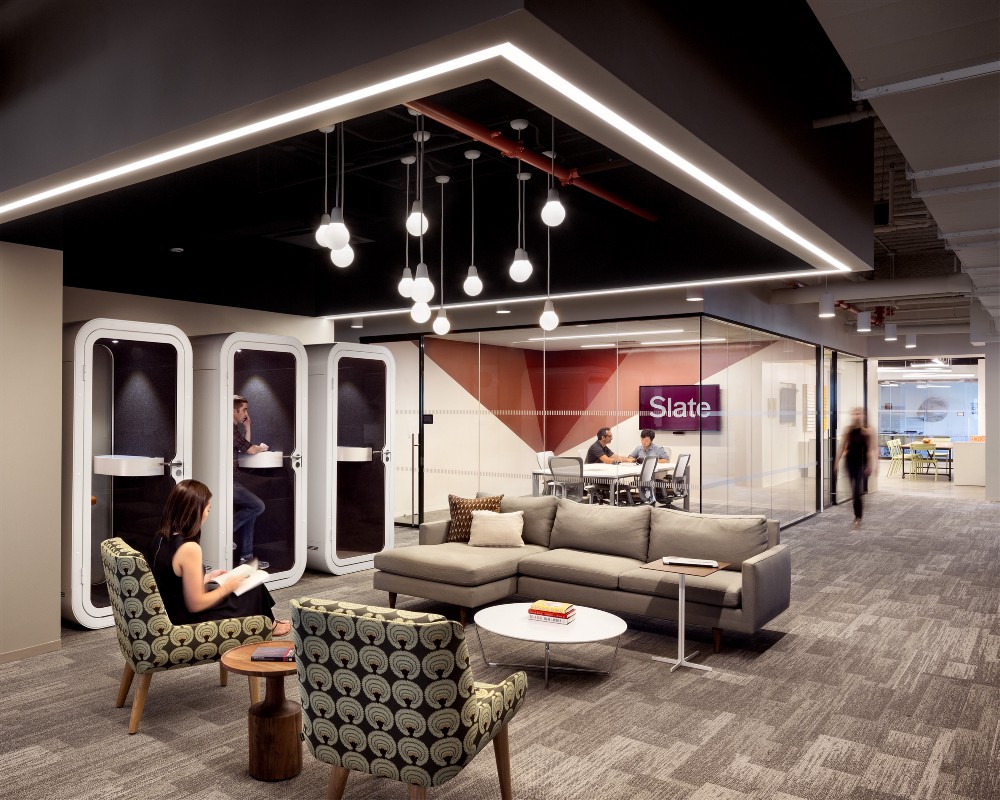
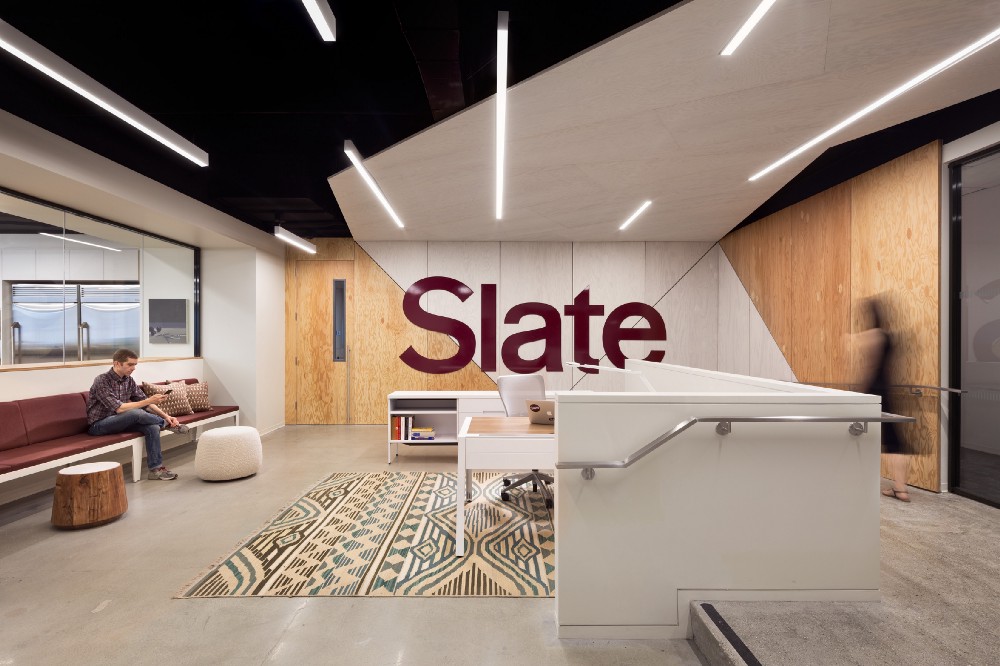
Everyone talks about creating a bespoke client space but I find that most firms invariably apply their own brand. I strive to understand as much about my clients’ culture, needs (current and future), as well as their aspirations. To me, the most successful projects are those where the client walks in and is overwhelmed by the beauty of the space but two months later realizes the full functionality it offers and how it can drive their business and culture. We recently completed the NY headquarters of Slate, which is a great example of form and function – every detail we planned for – from the phone booths to the collaboration areas – is used as we envisioned.
On her role at Unispace
Unispace is relatively new to the market so I’m working on sharing our process with the industry and familiarizing clients with our approach so they can come to see us as a trusted resource for problem solving through space. Internally, I’m working with our teams to rethink how we present design to our clients. I am constantly asking designers: are we getting our message across as clearly and effectively as we can? Are we showing our clients the full value of a design? Can they experience the space before it’s delivered? I want to push the envelope and try things that haven’t been done before – which is where recent advances in technology become truly critical.
Slate Magazine (Photographs courtesy of Unispace)
On recent projects that represent the firm’s unique approach
Our approach allows designers to break down traditional silos and seamlessly transition back and forth between design and construction. We explore cost and issues of buildability from the start of a project rather than through a post CD value engineering phase so we’re able to maximize time and budget with solutions that provide high design value. Two projects that stand out are Slate and DoubleVerify – both in New York.
On her design toolkit
This may sound old fashioned but I start with trace paper. I need to sketch first before I can move on to Revit and 3D technology.
We sometimes forget that our clients are not taught to read plans & elevations. Even 3D renderings can sometimes fail to convey the volume, scale and proportions, and adjacencies, which can make it hard for clients to fully experience and appreciate the thinking and story behind our designs. This makes me and my team work harder to find better ways to communicate with our clients.
On the DoubleVerify project, we brought in 3D modeling as early as the test fit phase and virtual reality in schematic design. This allowed us to effectively communicate all the right volumes and help our client understand the flow of their new space and the relationships within. The client felt that they experienced the space before it was built and felt confident in making decisions quicker than they would have through a traditional process.
DoubleVerify (Renderings courtesy of Unispace)
On the state of design software today
There are so many incredible tools available to us now which help us design more effectively and accurately but this can also feel a bit overwhelming to designers who may have gone to school a few years ago. I think it’s important not to get lost in the technical possibilities of today’s software at the expense of a design’s intent. I tell my teams not to focus exclusively on creating beautiful renderings – we still need solid concepts to build upon and create meaning from. I sometimes ask myself if we’re losing some of the art and romance of design as we forget how to draw by hand.
On the future of architecture in the next 5-10 years
I’ve been asking myself that question from the start of my career. The traditional model is segmented and pits disciplines against each other which ultimately doesn’t work to the advantage of the client. Disciplines need to come together, integrate their processes from the onset, and collaborate to create and deliver projects.
Silos will break down thanks to technology allowing us to collaborate across disciplines, use building materials we couldn’t before, and conceptualize space in a more complex way. Our processes will also continue to become faster and more efficient translating to shorter delivery times.
DoubleVerify (Renderings courtesy of Unispace)
On the future of Unispace in the next 5-10 years
Unispace is disrupting the industry. We’re bringing together top talent from the fields of design, technology, strategy, and construction and pushing ourselves to rethink the way the workplace is conceived and delivered. We have started to incorporate BIM technology into our workplace strategy offering to provide clients with more accurate test fits and cost models far earlier than the traditional design process allows. I believe we’ll continue to work in this vein, push boundaries, and use technology in ways traditional, siloed firms cannot.
On advice she would give her younger self
I would tell my younger self to intern at not just design firms, but with potential clients, lighting manufacturers, and construction companies. These disciplines are interwoven like a spider web – understanding this has changed my perspective on the industry and how best to approach a project. I’d also tell myself to pay more attention in 3D tech classes!
Joris Putteneers
Experiment, Sint Lucas Architecture 25/10/2016
Docent: Corneel Cannaerts
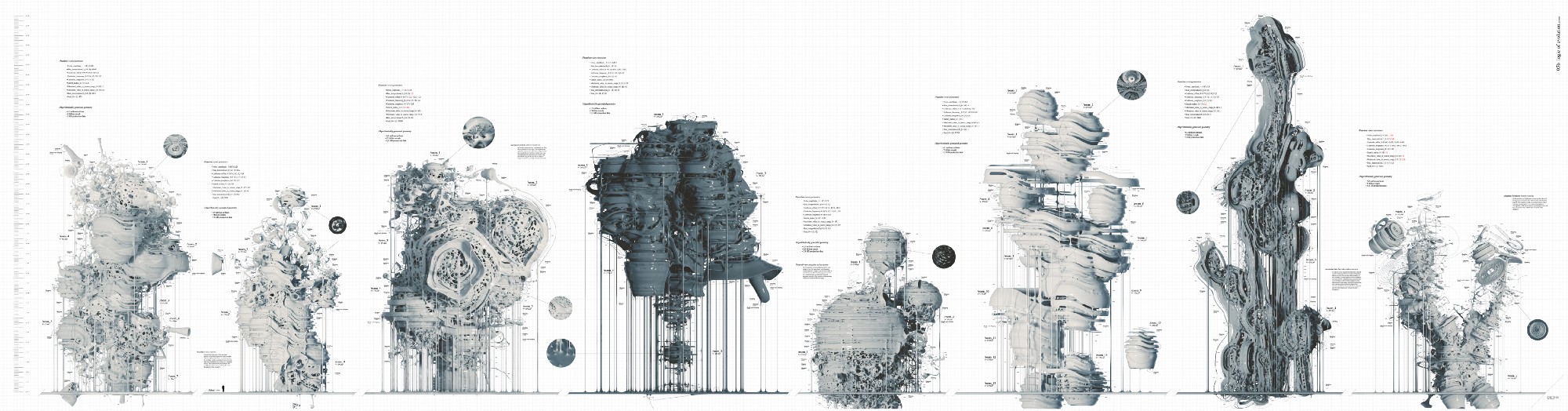
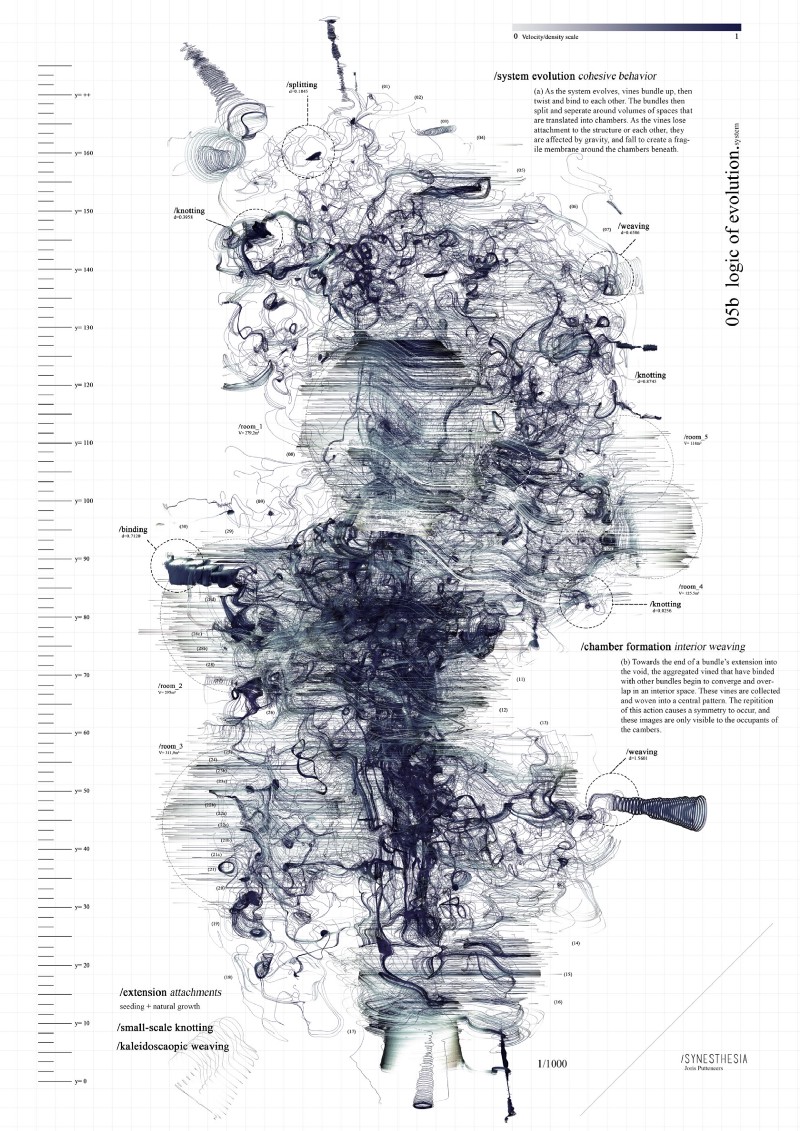
Synesthesia is a project influenced by the works of Francois Roche. It is made with the intentions of creating an architecture that defies classification and reductionism. I try to explore unexplored levels of resolution and topological complexity in architecture by developing a series of compositional strategies based on purely geometric processes. In this project, I use a coalescence of two algorithms to create a growing structure that appears at once synthetic and organic.
This single process generates many scales of architecture, from the overall form with its broad curvature, to local surface development, down to minute textures.
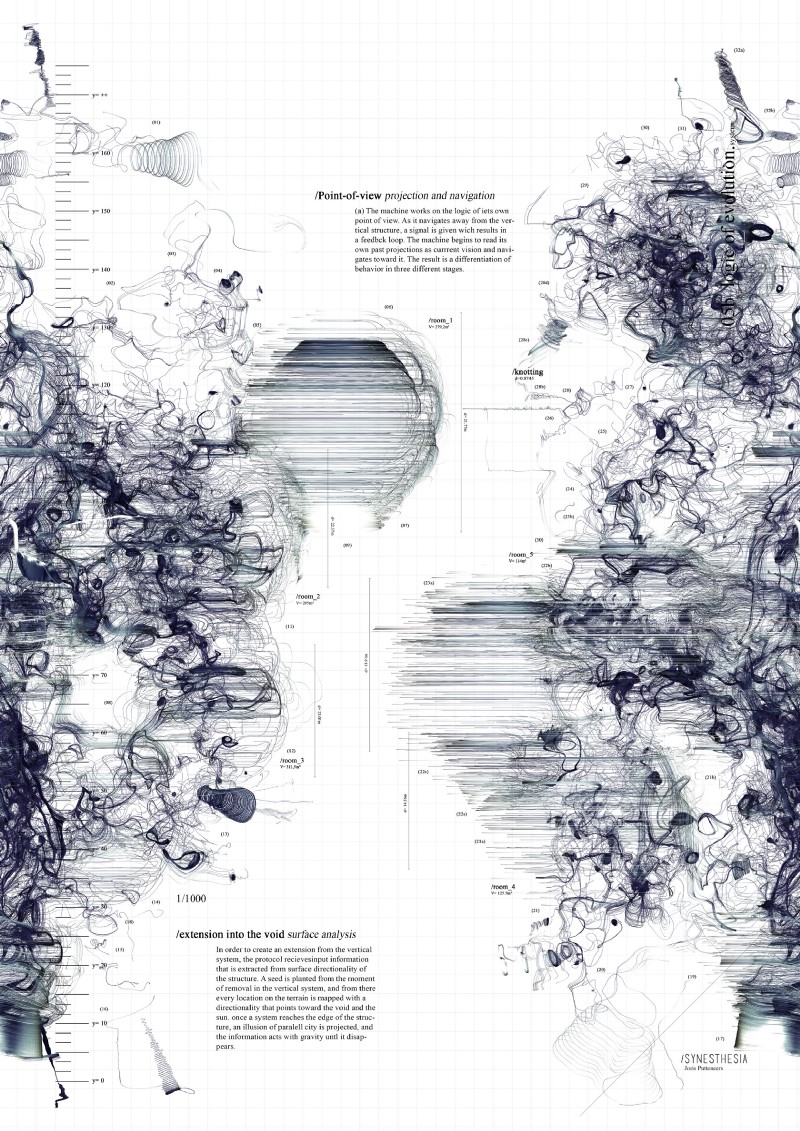
The design process strikes a delicate balance between the expected and the unexpected, between control and relinquishment. Although the algorithms do not incorporate random values, the results are not necessarily entirely foreseeable either. In order to create an extension from the vertical system, the protocol receives input information that is extracted from surface directionality of the structure.
A seed is planted from the moment of removal in the vertical system, and from that point on, every location on the terrain is mapped with a directionality that points towards the void and the sun. Once a system reaches the edge of the structure, an illusion of parallel cities is projected, and the information acts with gravity until it disappears.
As the system evolves, vines bundle up, then twist and bind to each other. The bundles then split and separate around volumes of spaces that are translated into chambers. As the vines lose attachment to the structure or each other, they are partially affected by gravity and by the search radius of the nearest vine.
Towards the end of the bundle extension into the void, the aggregated vines that have bound with other bundles begin to converge and overlap in an interior space. These vines are collected and woven into a central pattern. The repetition of this action causes a symmetry to occur. These images are only visible to the occupants of the chambers.
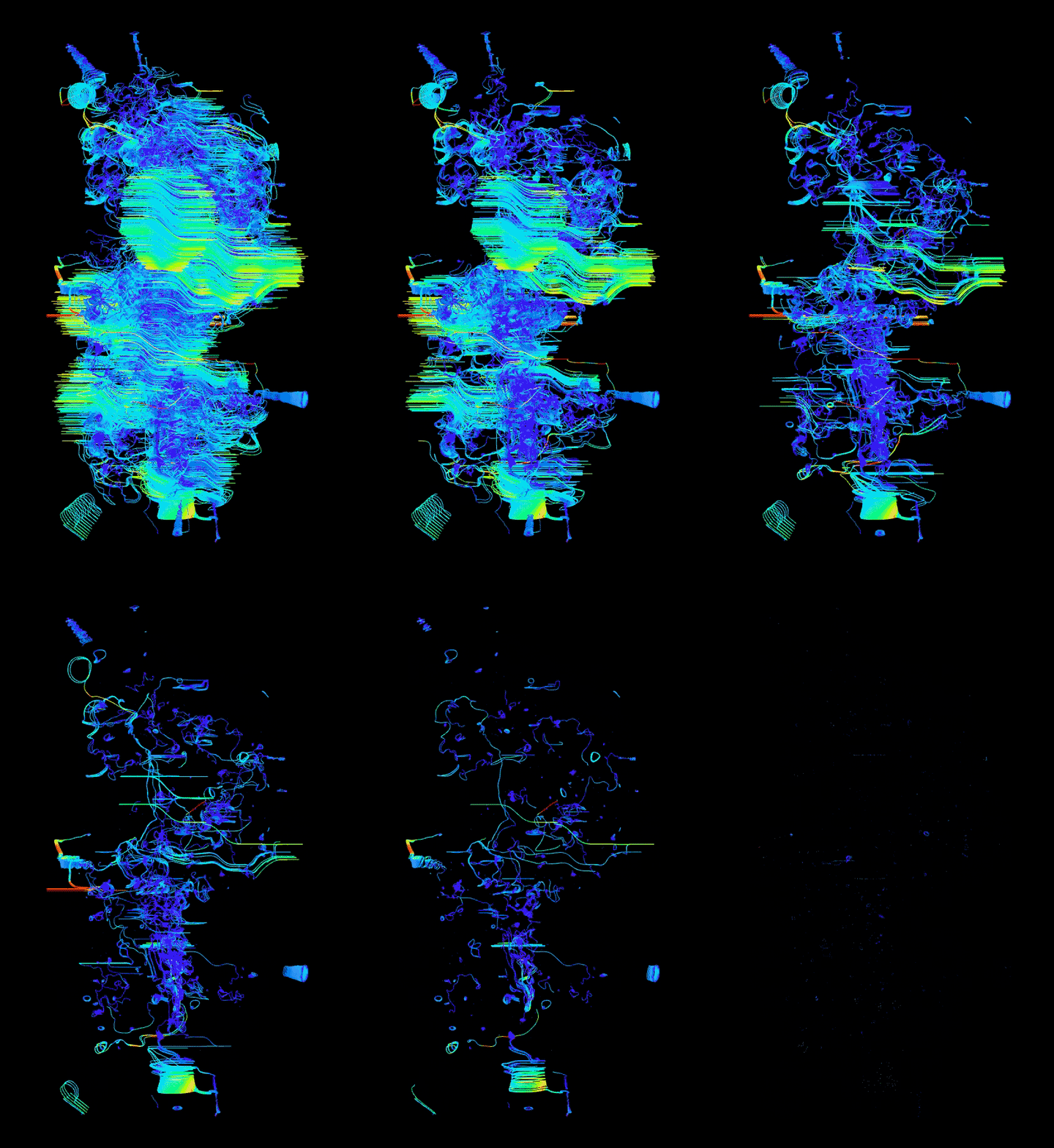
The machine works on the logic of its own point of view. As it navigates away from the vertical structure, a signal is given which results in a feedback loop. The machine begins to read its own past projections as current vision and navigates towards it. The result is a differentiation of behavior in three different stages. Initiation, Transition and serenity.
Towards the final stage of the machine’s journey, it becomes hyperactive and overfills with its collection of vines. As a consequence, the machine expels a coating of resin, leaving behind a structural membrane on its vines as a continuous weave. the resin solidifies and captures the modification of the vines, defining the outer boundaries of the chambers. The processes can devise truly surprising topographies and topologies that go far beyond what one could have traditionally conceived.
Synesthesia is between chaos and order, both natural and the artificial. Any references to nature or existing styles are not integrated into the design process, but are evoked only as associations in the eye of the beholder. Such a hierarchical differentiation can also be found in classic architecture. Yet unlike traditional architectural design processes, here a single process is used both to sculpt the overall form, and to create the surface details.
This articulation can be used to create features that exceed the threshold of human haptic or visual perception that would be entirely un-drawable using traditional means.
Virtual:
• Algorithmically generated geometry
• 18000 vectors
• 9 million surfaces
• 2,6 billion voxels
• 12 GB production data
Design Development:
˜80 hours in the course of 5 weeks
Team
Fabrication: Joris Putteneers
Video / Photo: Joris Putteneers
Mentor: Corneel Canaerts
Since 1999, NEXT architects has developed a highly diverse practice that encompasses research and design projects in the fields of urban planning, architecture, interior, and infrastructure. NEXT continuously explores the boundaries of design, actively seeking exchanges with other disciplines. NEXT specializes in the creation of unique bridges that capture the imagination of the viewer.
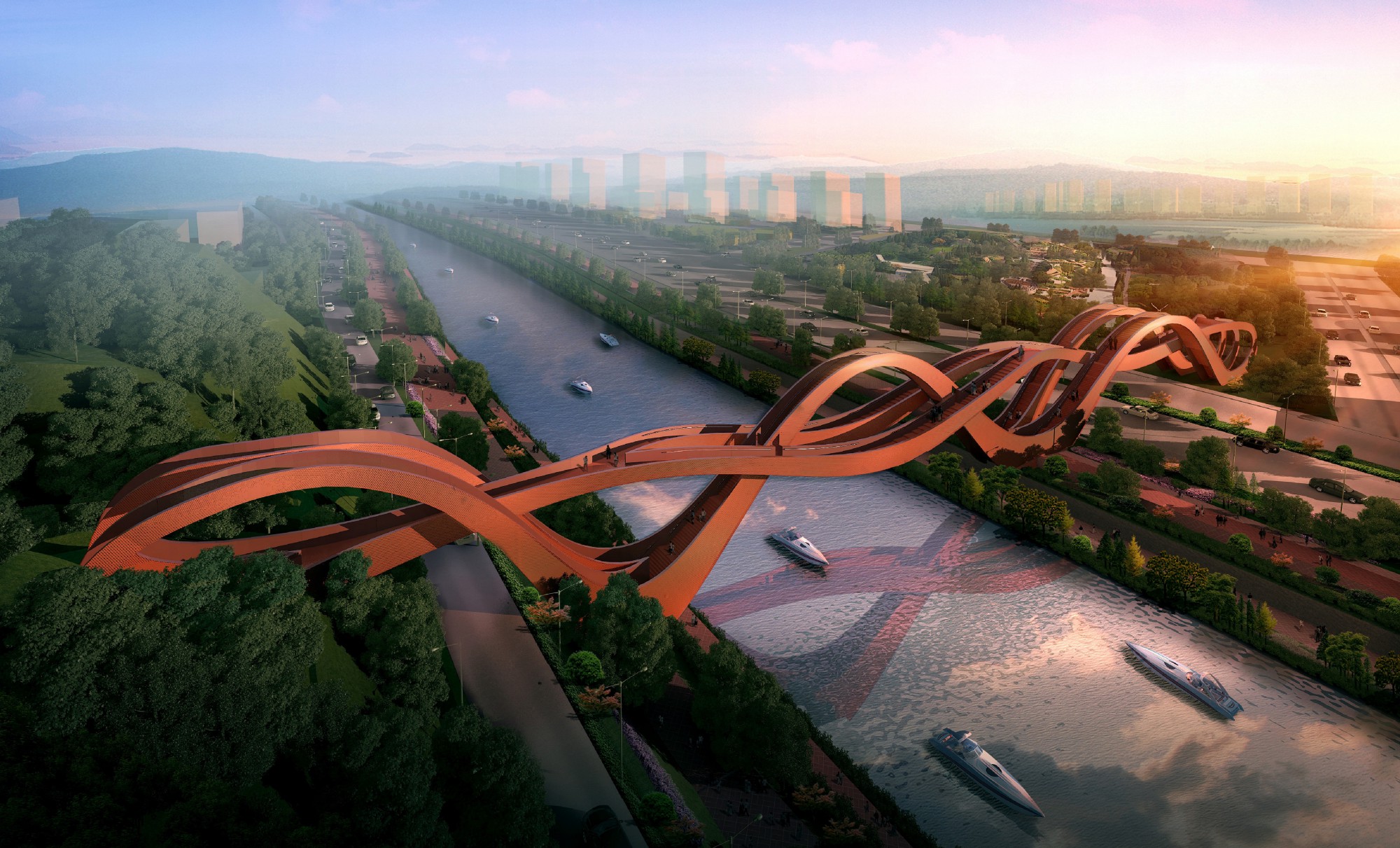
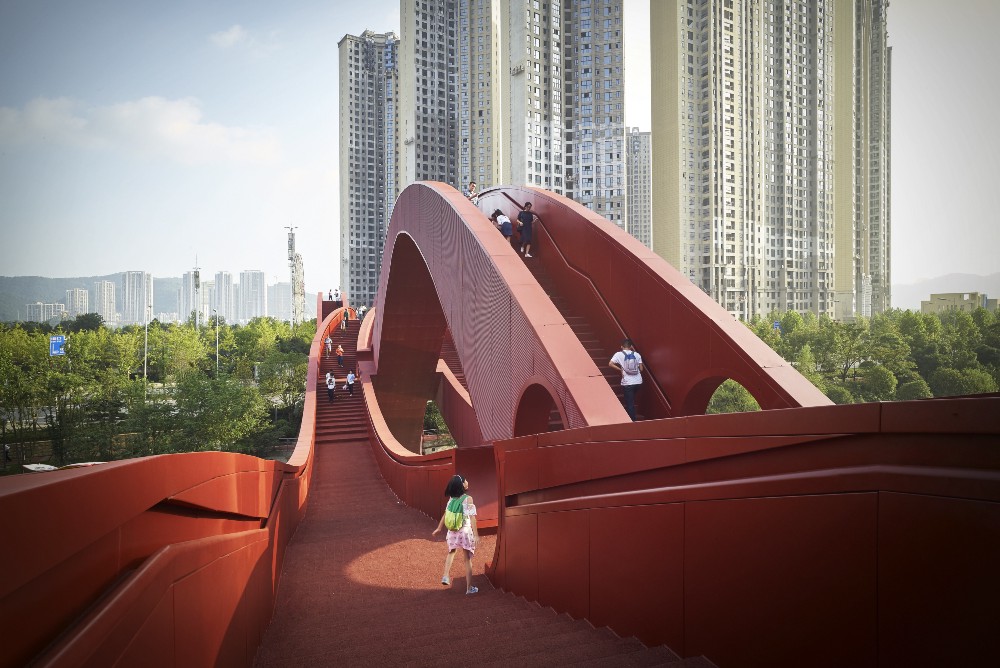
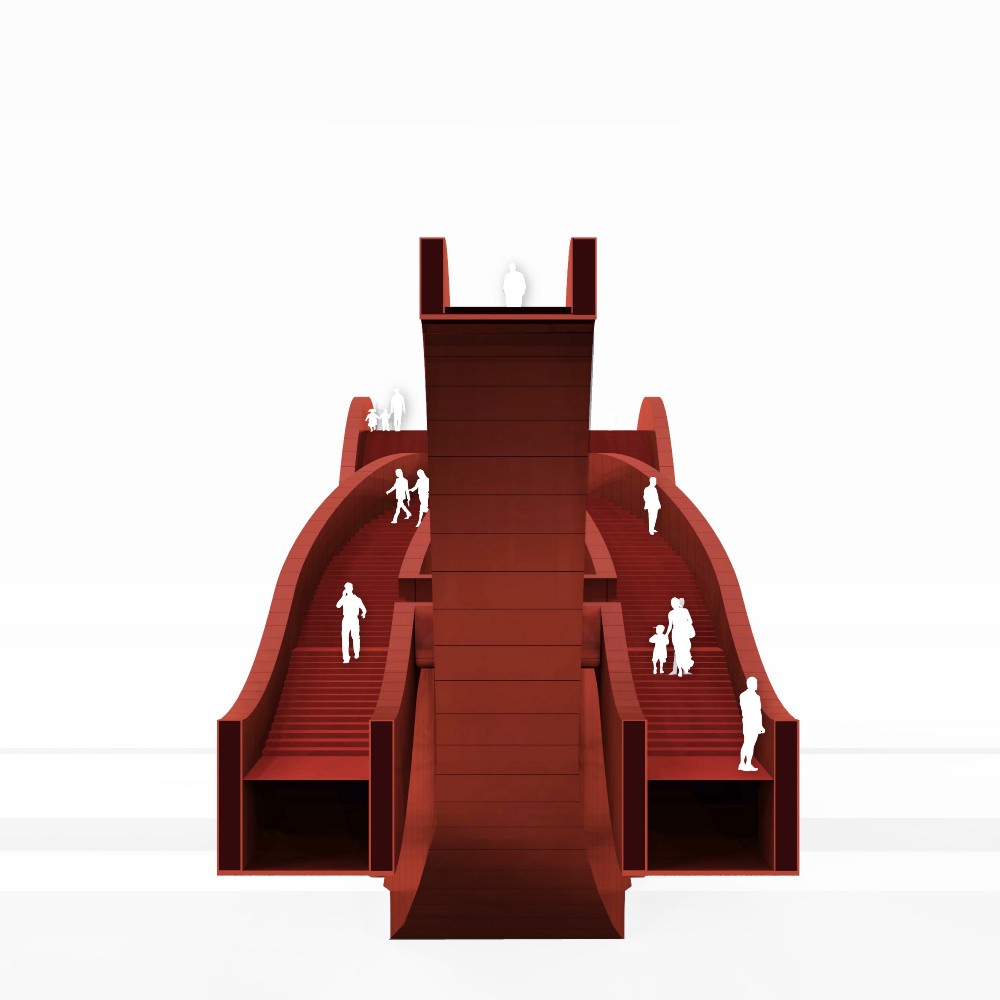
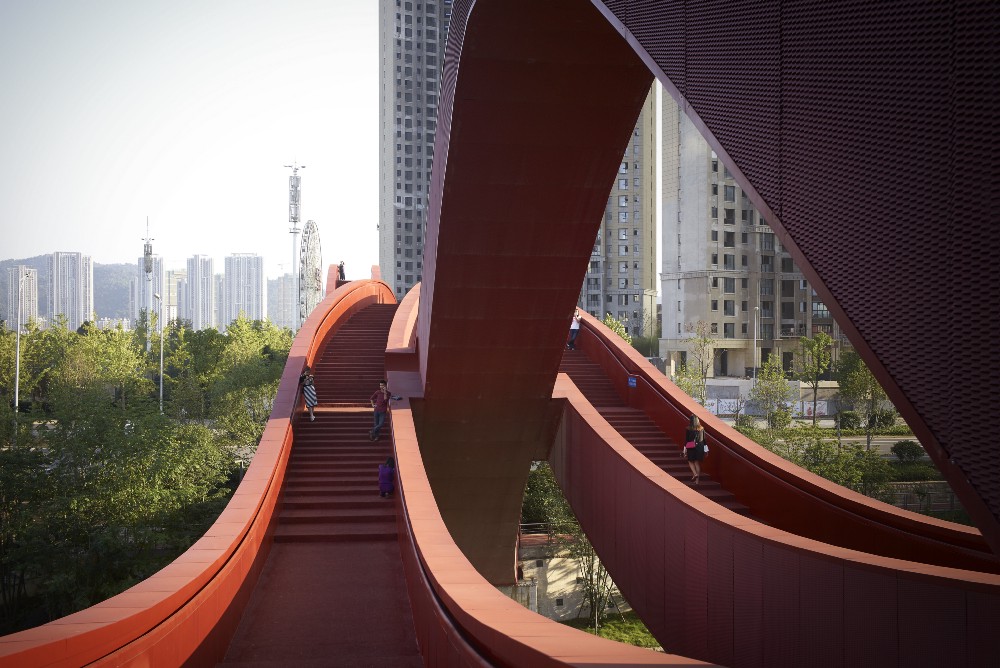
NEXT Architects is working on a unique series of bridges all over the world. This time, their latest design isn’t an intriguing bat bridge (nominated for the 2016 Dutch Design Awards), but an iconic bridge in China: the Lucky Knot. The new steel pedestrian bridge in the Chinese mega city Changsha is 185 meters long and 24 meters high and fits perfectly in the sequence of extraordinary bridges that characterize NEXT’s practice; by explicitly engaging with the local context, the bridge designs offer new perspectives.
The eye-catching Lucky Knot has down-to-earth Dutch roots. NEXT architects holds offices in Amsterdam and Beijing. In 2013, after the completion of their breathtaking Melkwegbridge inPurmerend, NEXT was invited to take part in an international competition to design a new bridge to be constructed over the Dragon King Harbour River in Changsha’s rapidly developing New Lake District’. For this special commission, the teams in Amsterdam and Beijing joined forces to come up with the unique, winning design: the Lucky Knot. Combining the Dutch team’s expertise in infrastructure and water management and Chinese team’s perseverance and knowledge of the local context was a crucial part of the process. The bridge has already become an icon, and was selected by CNN as one of the “most spectacular bridges that break the mold.”
“NEXT’s designs for both international and national clients distinguish themselves for their singular relationship with their surroundings, their enhancing of the experience of the specific location, and their added value to the site. This is also the case in Changsha. The city is growing and changing rapidly. This context called for a unique gesture to inspire passers-by,” comments Michel Schreinemachers, partner at NEXT architects Amsterdam.
A thousand and one steps
The bridge is a key project in developing the area’s public space, and was designed with recreational, ecological and tourist activities in mind. The bridge connects multiple levels at different heights (the river banks, the road, the higher-placed park as well as the interconnections between them). The final shape of the bridge is the result of — literally and metaphorically — knotting all these routes together. “The shape of the Lucky Knot was inspired by the principle of the Mobius ring, as well as by the Chinese knotting art. In the ancient decorative Chinese folk art, the knot symbolizes luck and prosperity,” says John van de Water, partner at NEXT architects Beijing. The bridge owes its imaginative appeal to the combining of tradition and modernity.
“The Lucky Knot is more than a bridge and a connection between two river banks. Its success lays in bringing cultures together, and in the fusion of history, technology, art, innovation, architecture and spectacle,” adds NEXT architects Beijing partner Jiang Xiaofei,
The Lucky Knot connects, illuminates and entertains. The bridge offers a spectacular view of the river, Meixi Lake, the city of Changsha and the surrounding mountain range. Thanks to its remarkable LED lightshow, the bridge is set to become a landmark attraction in the light route that traces the path of the Dragon King Harbour River.
Hyuntek Yoon
Dialogue between the Theater and the City
Harvard GSD M.Arch 1 Thesis
Program: Theater
Location: Busan, Korea
Year: 2012
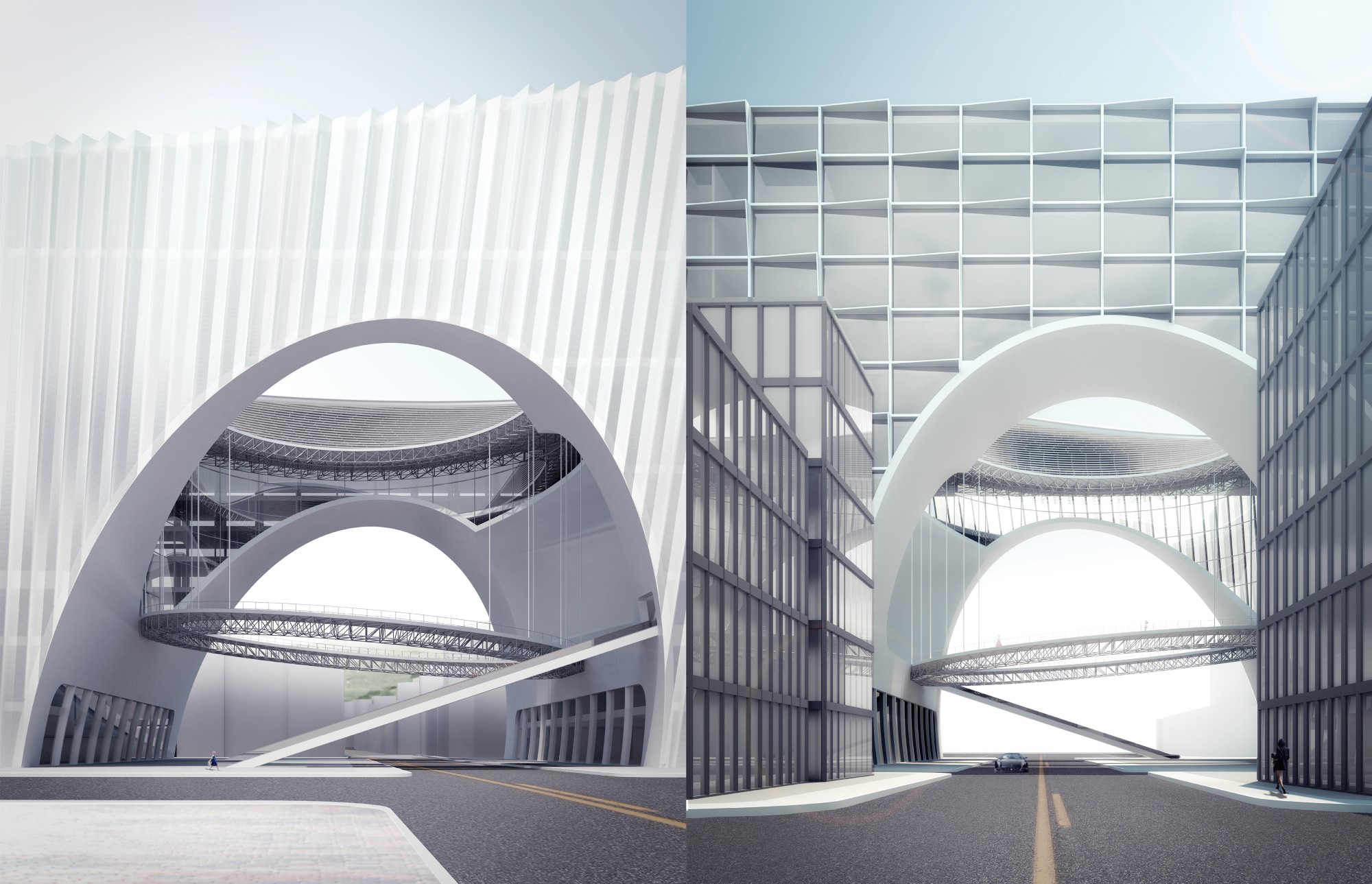
The theater was originated from ancient Greek. It arose as a performance of ritual and civic activity. For last 40 years, the theater has been built as the icon of the city. Many cities tried to express their economic and cultural growth by the sculptural gesture of the theater. However, theater’s iconic image overwhelms its function. The theater is isolated form the city in term of programs and location. The new theater typology will provide the chance which the theater can communicate with the city. Theater needs to be iconic, and at the same time it must have close interaction with the city. Theater as a cultural and public building, it must create and accommodate diverse social environment and interactions.
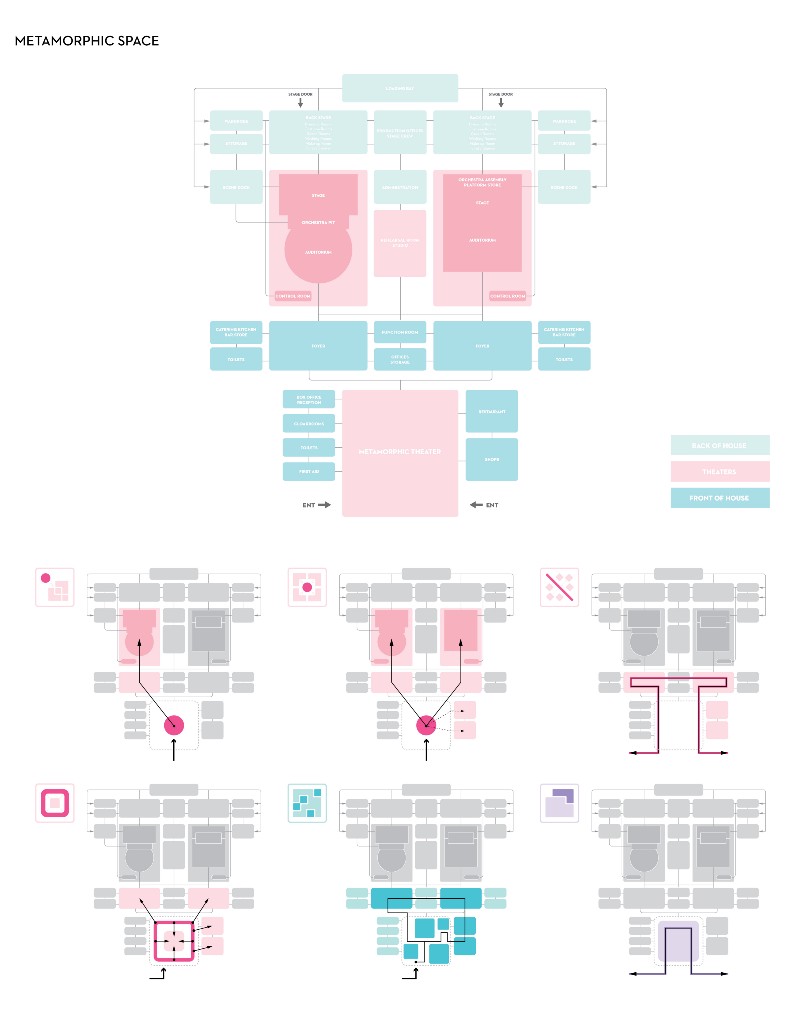
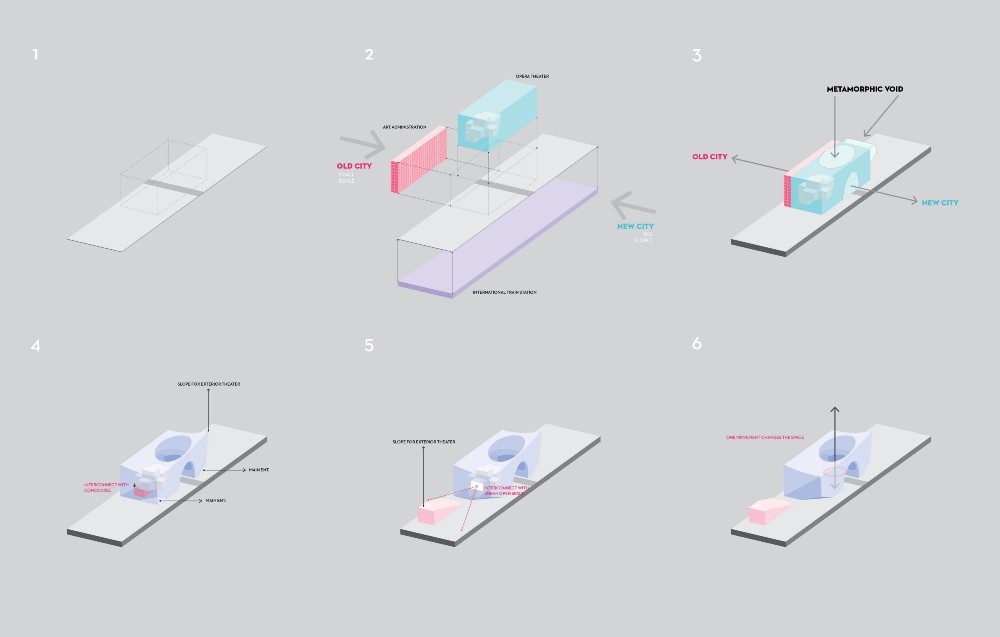
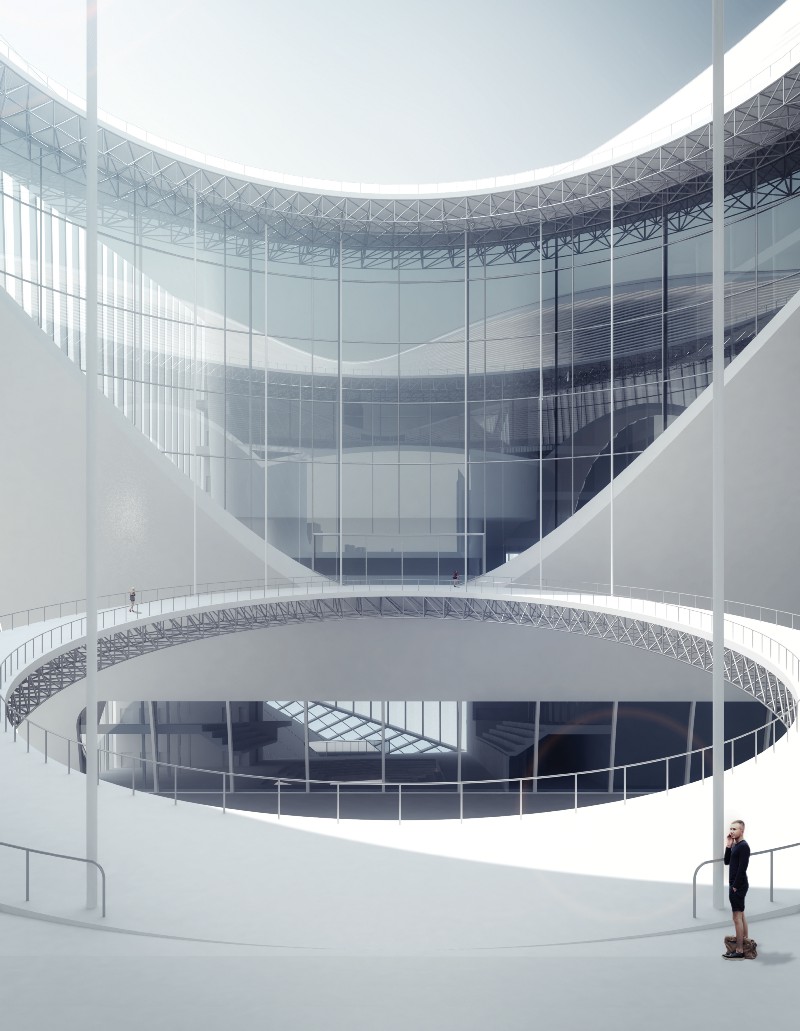
The new theater is composed by typical theater and series of voids. These voids, called as Metamorphic void, keep changing depended on time and programs. Voids will operate overall building in terms of program and spatial relationship. The void is changing its function. Void can be circulation link, and the way of link also diverse, and sometime the void support main program and sometime it works as independent program. Metamorphic void is not physical transformation; rather it is related on changing relationship between spaces.
Three Metamorphic Voids
Opera Theater
The proscenium theater is used like typical opera theater.
For the special performance back stage changes to main stage.
Concourse & Multi-Purpose Theater
Concourse is visually connected with the stage of the multi-purpose theater.
For larger scale of performance, ground level foyer and concourse changes to large interior theater.
Transforming Void
The bridge down: the bridge is used as path for opera theater, and roof garden is working as amphitheater.
The bridge up: the bridge is working as a large fly tower, and public open space changes to stage.
Design Manifestos: Vishaan Chakrabarti of PAU Studio
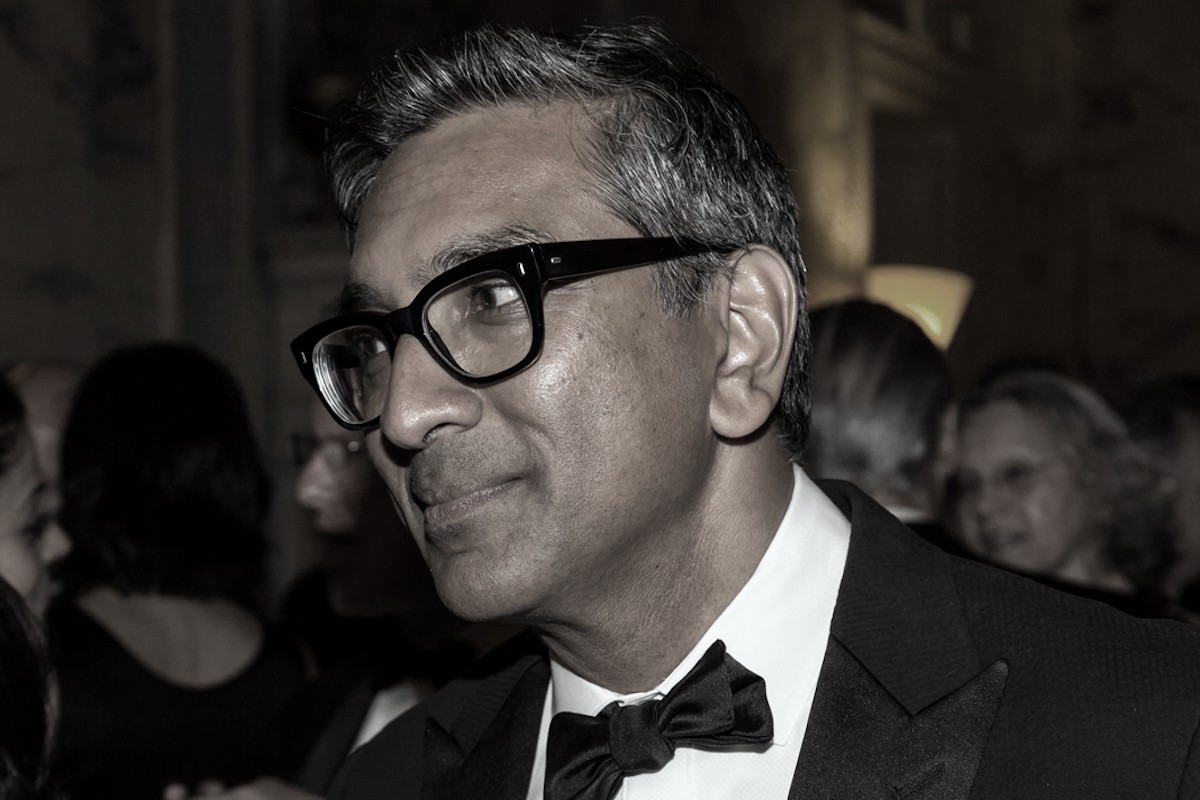
Vishaan Chakrabarti (Photograph courtesy of PAU Studio)
Vishaan Chakrabarti, AIA, is a registered architect and the founder of PAU. Simultaneously, Vishaan is an Associate Professor of Practice at Columbia University’s Graduate School of Architecture, Planning & Preservation (GSAPP), where he teaches architectural design studios and seminars on urbanism. He serves on the boards of the Architectural League of New York and the Regional Planning Association. He is a trustee of the Citizens Budget Commission, and is an emeritus board member of Friends of the High Line. He is also a member of the Young Leaders Forum of the National Council on US-China Relations and has served on the National Mayor’s Institute of City Design. Metropolis Magazine named Chakrabarti one of the top 12 “Game Changers” for 2012, he is a former Crain’s “40 Under 40” and David Rockefeller Fellow. Modelo spent some time learning about Vishaan’s journey through the profession and about founding PAU.
On becoming an architect
As a child we traveled a great deal; my father was a scientist and when he had speaking engagements we would tag along. On a shoestring budget we saw the world’s great cities, with art, performance, and food always at the center of our travels. In an effort to be A-Good-Indian-Boy I majored in engineering in college, but eventually completed a dual degree in both engineering and art history, a kind of left brain/right brain path that ultimately led me to architecture and city building.
On discovering his voice as a designer
As an author I believe to write one must read, and it is the same with architecture — to “write” with design, and therefore to express one’s voice, requires the “reading” of cities and culture, materials and tectonics, places and occasions. For example, my architecture thesis examined the design of an eye hospital proposed by my father on the outskirts of Calcutta, India, in which patients would slowly regain their eyesight in the days following surgery; the project raised intensely architectural questions of the haptic versus the retinal in terms of light, materials, construction techniques, and the reading of the specific cultural landscape of the West Bengal river delta.
My professional influences span many of the great urbanist architects and theorists including Richard Rogers, John Habraken, Kenneth Frampton, the Smithsons, and other members of Team 10. A wide range of cultural figures are inspiring to me artistically, from painters Jacques-Louis David, Mark Rothko and Agnes Martin; to photographers Henri Cartier Bresson and Gary Winogrand; to sculptors Constantin Brancusi and Richard Serra; to musicians John Coltrane and MIA; to authors Gabriel Garcia Marquez, Jeffrey Eugenides, and Donna Tartt. Academically I have been privileged to study with extraordinary design professors including Stanley Saitowitz, Tom Chastain, Kathleen James Chakraborty, Gary Hack, and Julian Beinart. Beyond the field of architecture, certain individuals have been inspirations in terms of actions, words and demeanor, particularly Barack and Michelle Obama.
Domino Building (Images courtesy of PAU Studio)
On starting PAU Studio
I started the Practice for Architecture & Urbanism (PAU) with the specific intent of founding a firm dedicated to re-imagining cities through enduring architecture and socially-impactful urbanism. Since the founding of the firm I have been energized by our collective ability to be true to our mission, taking only the commissions that provide the opportunity to help reinvent urban life. It will take some time for our current projects to be realized, but it is already evident to me that PAU will yield architecture that is specific to who we are and what we hope to achieve.
On specific principles he strives to adhere to
On our website, we have set forth a clear set of principles for our practice that are best expressed in terms of what we do and what we don’t do. We want to pursue cultural, institutional, commercial and infrastructural design projects that reinforce urban life. We are not interested in pursuing projects like suburban homes or office parks, casinos, correctional facilities, or commissions for nations or corporations with poor labor or environmental practices.
On his role as Founder of PAU Studio
As our founder my role is to lead our design work, mentor our team, and find commissions that align our ideals with our practice. I am also the bartender during our studio’s weekly happy hours.
Pennsylvania Station (Renderings and drawings courtesy of PAU Studio)
On recent projects that represent the firm’s unique approach
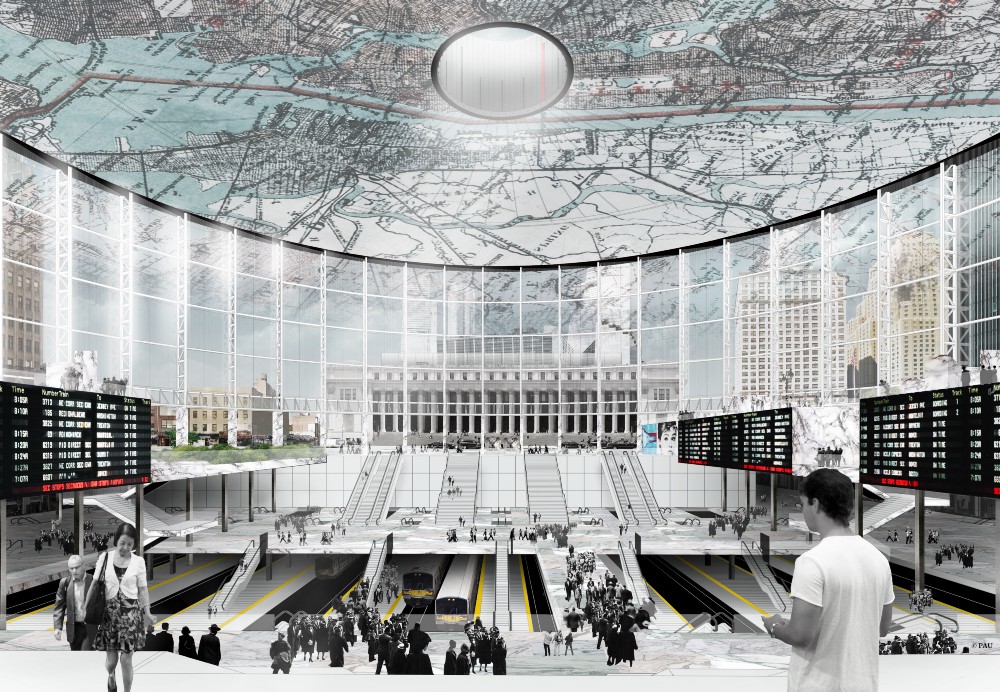
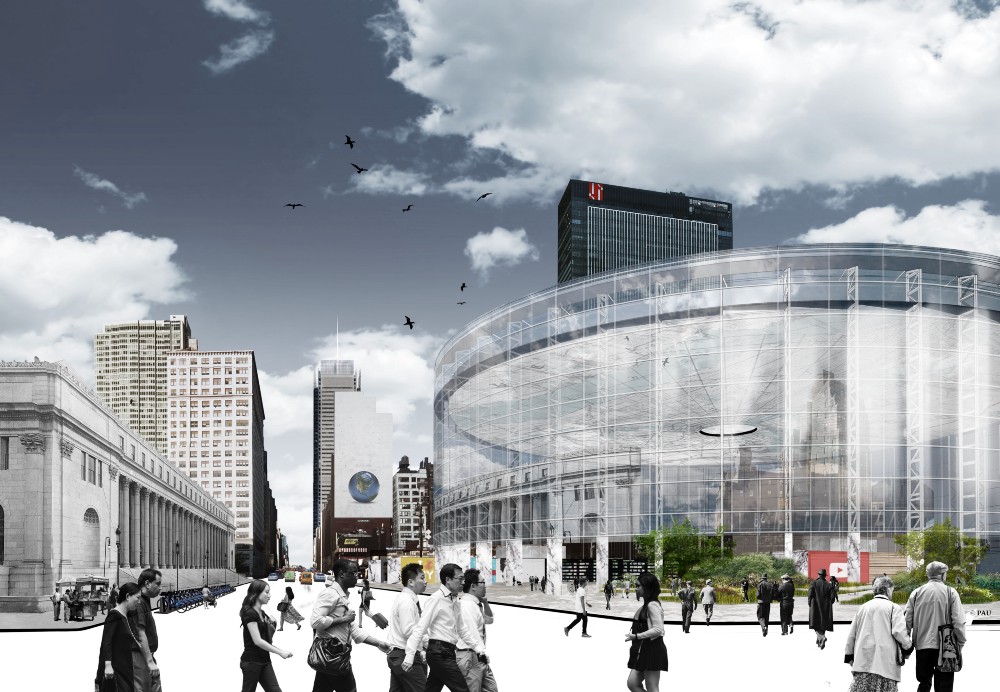
Our firm has a unique approach to design that explicitly entails the reading and writing of cities. The most representative project we can discuss publicly is our proposal to re-imagine Pennsylvania Station at the request of the New York Times. We made very specific architectural decisions governed by a palpable sense of self-restraint; we did not feel this building should be about PAU or its founder, but instead should be about arriving in the heart of New York City into the busiest transit hub in the Western hemisphere. As architects who believe deeply in urban public space we proposed the largest enclosed civic space in New York City, without a grand public price tag, by recycling the existing circular structure of Madison Square Garden once they have relocated to a new home. The specific architectural decisions include recladding the structure in a double-skin glass curtainwall to reveal the city from the station while passively heating and cooling it; the inner layer of glass would be arranged in a saw tooth pattern in plan in order to capture and reflect the specific light that strafes Manhattan’s side streets, colloquially known as “Manhattanhenge.” Conceptually this lightweight tectonic structure of roof, columns and glass would rest upon a stereotomic base rising from the below-grade platforms, culminating in a stone colonnade that would rise from the sidewalk level to create a durable and civic stone carpet around the entire perimeter of the cylinder, fluidly merging the space of the station with the space of the city. With inspiration from the stars on the ceiling of Grand Central, we have adorned the ceiling of the new Penn Station with a map of New York, orientating travelers as they emerge from their trains.
Pennsylvania Station (Renderings and drawings courtesy of PAU Studio)
Our other projects include a major Manhattan mixed-use commercial tower with significant transit connections below; a Brooklyn office building with a vocational school at its base; a new transit connection across the East River; the design of a major public space in Midtown; the reconceptualization of a public housing site in Mexico City; master plans for major waterfront sites in San Francisco and Newark; and technologically futurist architecture and design for Sidewalk Labs. While none of this work is available yet for public release, we are confident that it represents a body of work that is indicative of a unique point of view in terms of both design expression and cultural meaning.
On his design toolkit
Our process often begins with me writing an essay about the project and the site, which usually includes observations about the project’s meaning, purpose and possibilities within the context of the city in which it is located. To supplement this essay, we generate sketches, photographs, collages, study models, and yet more sketches. Slowly we translate the site to the computer, typically using a combination of Rhino and Grasshopper. We tend to build three dimensional digital models prior to the creation of specific plans and sections on the computer, again moving back and forth between hand sketches and the Rhino model.
When the design reaches a certain point of maturity do we use AutoCAD for drawings, with painstaking attention given to line weights and dimensions. We try to avoid hyperrealistic renderings, opting instead for collages, section perspectives, axonometrics, diagrams, and other drawing types to communicate the design.
On the state of design software today
Design software is a powerful tool, no more, no less. We do not use software as a means to generate design, which comes much more from the head, hand and heart. Software is a powerful tool to resolve geometry, analyze problems, and express design intent. We imagine that the future will bring us more powerful software tools, but we do not imagine those tools as ever being a substitute for talent.
Pennsylvania Station (Renderings and drawings courtesy of PAU Studio)
On the future of architecture in the next 5–10 years
The language of architecture needs to become multivalent. To regain relevance architects could embolden design to be a horizontal rather than a vertical by reinventing their practices to bridge across the siloes of buildings, cities, ecologies, economies, and communities.
Design could be the cultural bridge that spans the gaping chasms of our time.
With the emergence of figures like Alejandro Aravena, Shigeru Ban, and Tatiana Bilbao, leading architects are bridging the false divide between design excellence and social impact that evolved out of the celebrity era of the late twentieth century. Our newest generation of designers, millenials, came of age at the outset of the twenty first century, when resource constraints returned to the fore as a consequence of economic and environmental hardship. The irrational exuberance of the nineties already feels distant, and with this new generation of young talent and new leadership, we will see a resurgence of design architecture with socially progressive ambitions, a reinvention of the idea that less can indeed be more.
On the future of PAU in the next 5–10 years
PAU will respond to the pressing and evolving challenges of our era. We will always strive to be a practice focused on social impact through the tangible advancement of cities, a practice naïve enough to believe that the very definition of lasting design is to create architecture and urbanism that will tackle society’s challenges and reimagine urban life in their wake. We exist to help reinvent the city of the future, to advance the values of liberté, égalité, et fraternité that undergird metropolitan life, to design cities, buildings, public spaces, infrastructure, and urban technologies that are of, by, and for the global civilization we seek to serve and advance. We take on this mission informed by our decades of experience, yet guided by the ideal that by reinventing cities, we can help shepherd our shared world to betterment, self-reflection, and public delight.
On advice he would give himself
To have faith in myself, my ideas and my design abilities regardless of what others think. Most of us struggle with this when we are young, and to prevail in that struggle is one of the great gifts of age.
Kara Biczykowski
Yale School of Architecture AU 2014
Critics : Sam Jacob, Sean Griffith, Jennifer Leung
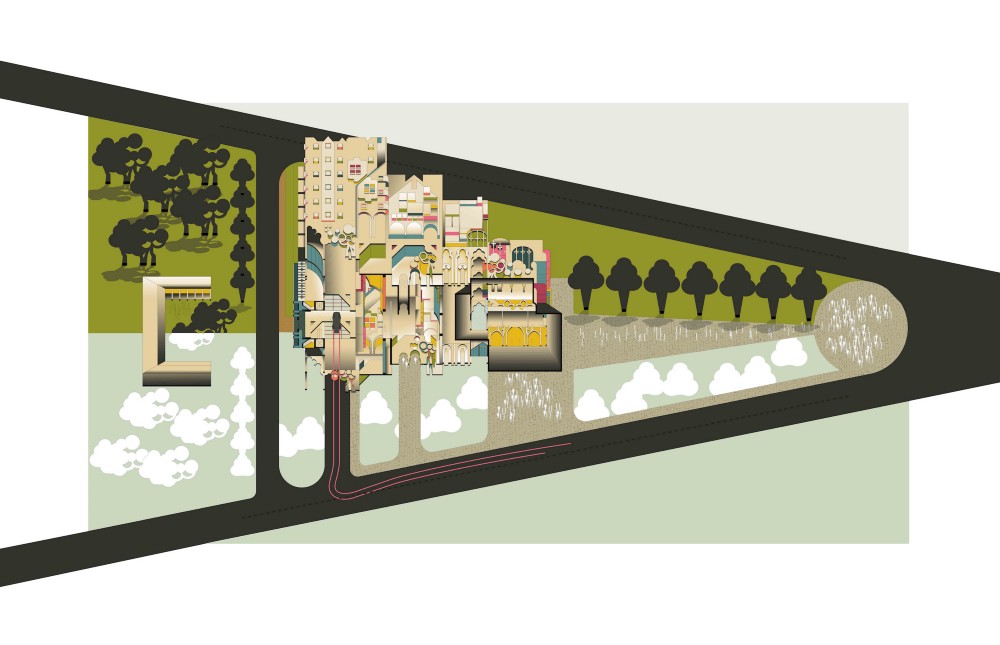
Vauxhall is currently one of London’s larger sites being developed as the city looks to a 21st century future. Various influential projects in the area include the construction of the new American Embassy and the refurbishment of the Battersea Power Station.
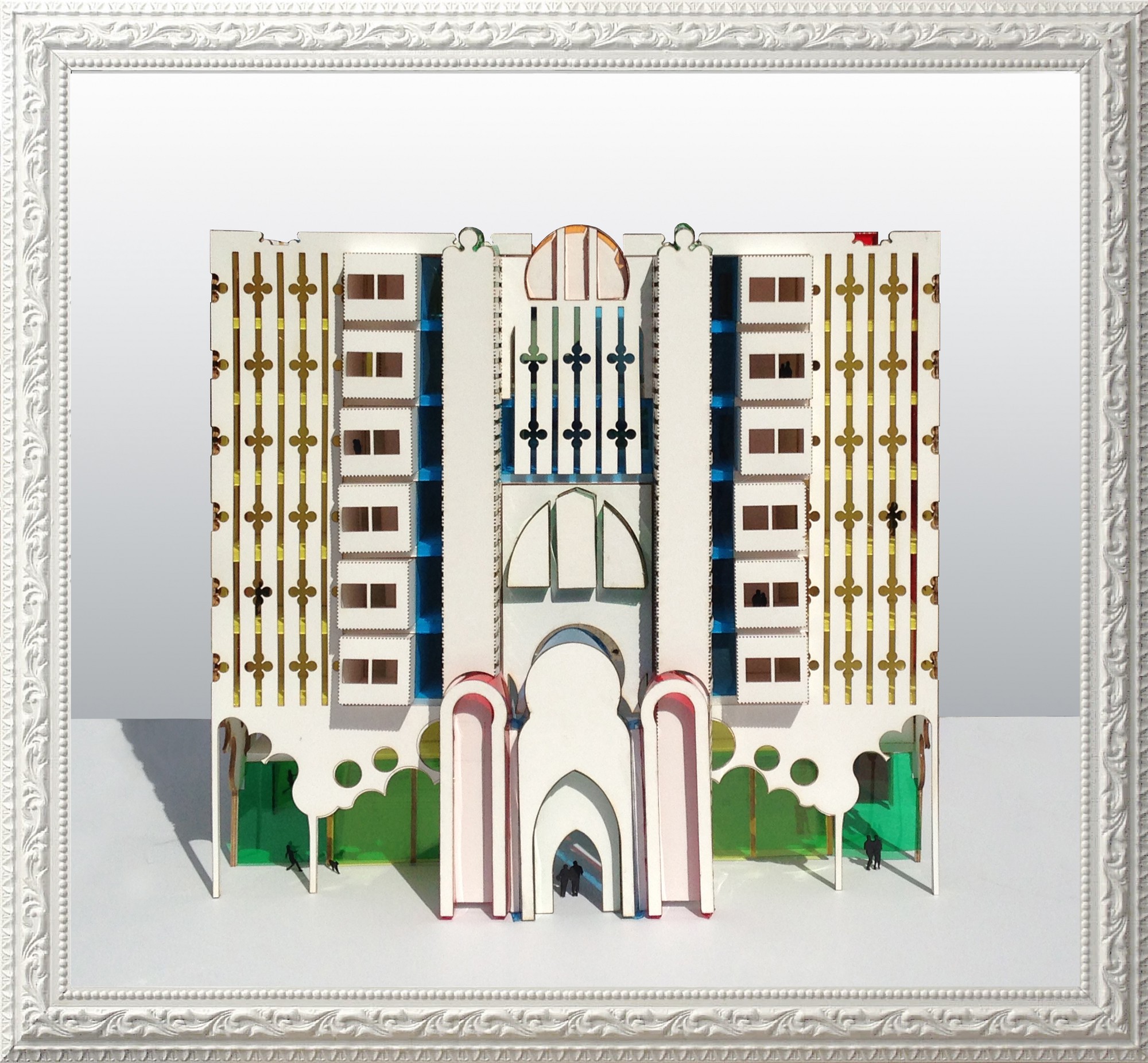
The proposed hotel hopes to function both as a gateway for embassy employees arriving for short periods of time and long term immigrants. The idiosyncratic clash of a non-denominational prayer hall for immigrants with various backgrounds and the hotel for embassy and event guests provides an inventive typology to accommodate needs of both local and visiting groups.
The scale of Vauxhall becomes an issue as surrounding built work does not relate to a human scale. The hotel uses a telescoping technique to slowly introduce visitors into the site after crossing the Thames River and gradually grows in size to blend into its neighboring context.
The hotel’s organization provides versatile functions for a hotel lobby/lounge, prayer hall, wedding hall, funeral hall, party venue, and more. This organization is initially structured off of a typical Latin cross plan; however rooms are stacked above the “aisles” next to a “nave” where two transepts then slice through the hotel creating atriums for sunlight access.
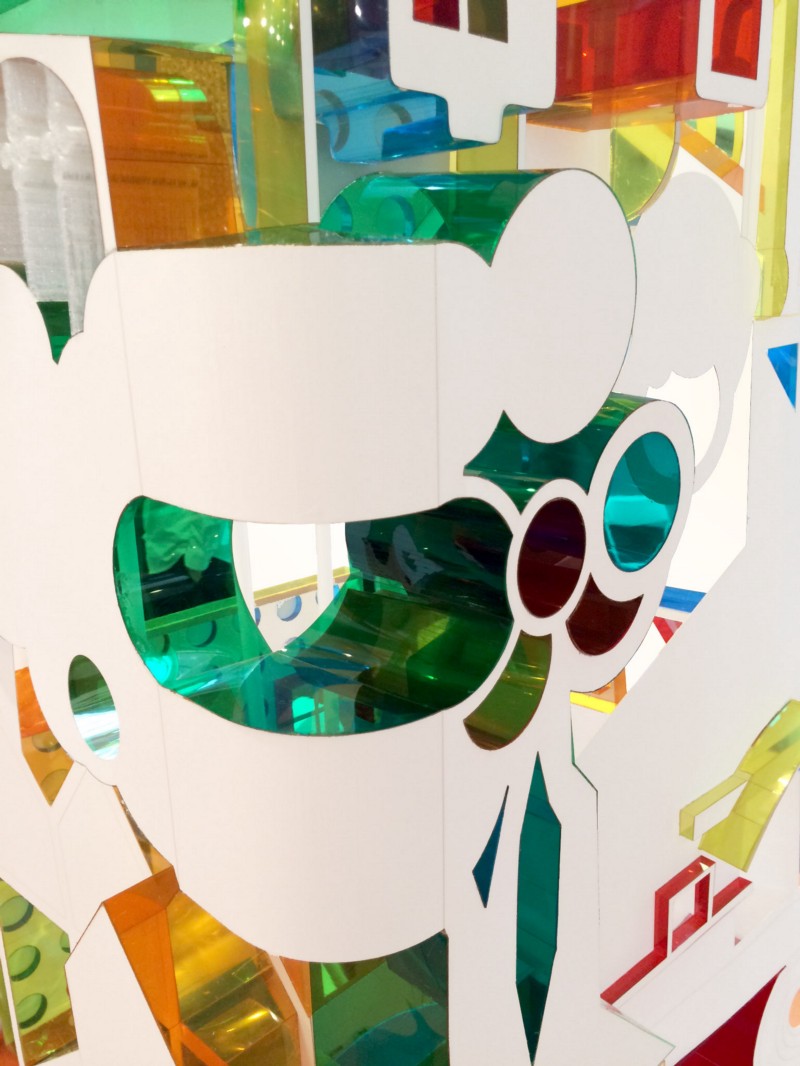
The ground level can transform into a colonnaded Mosque prayer hall or remain divided for small intimate gatherings. The “nave” ends in a space devoted specifically for any religious event. The tectonic assemblage of volumetric components creates opportunities for light to enter indirectly through various colored glass. This also provides privacy and a stronger sense of community for guests and visitors. The tectonic volumetric forms draw from the natural environment. For example the hotel appears to sit within a forest as references to tree canopies that sculpt the building’s base.
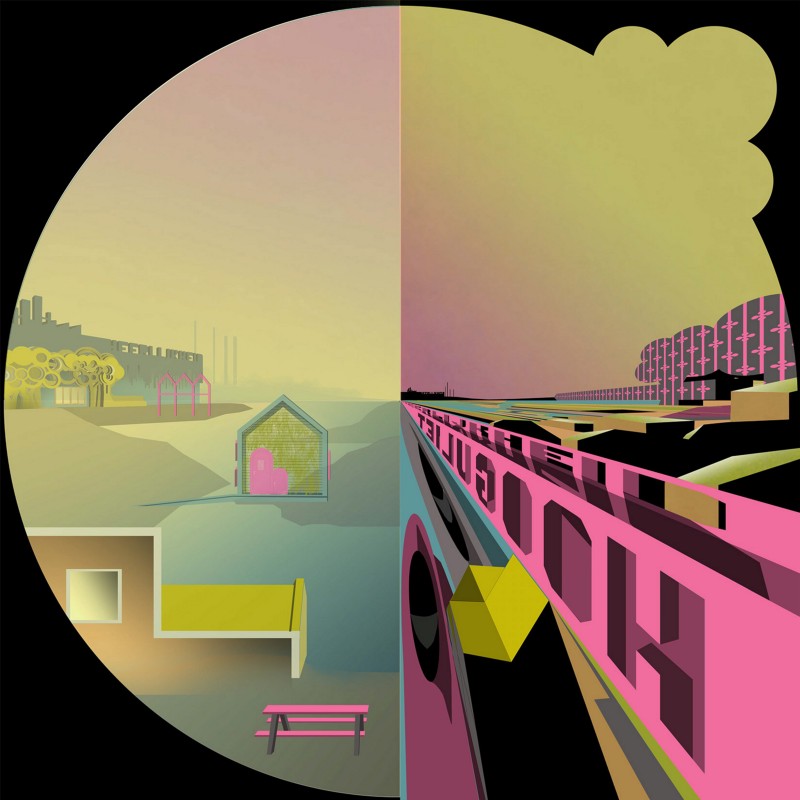
The project establishes the inventive and provocative role drawing and representation influence on the communication of architecture and the design of physical buildings.
The final concept was achieved after a progression of studies between drawing, hand modeling, and computer software.